by
by Onstage Behavior: Why It’s Funnier Than You Think
by Alan Nafzger | ComedyWriter.info
Ask a brand-new comic what matters most in stand-up, and they’ll say, “The jokes.” Ask a comic who’s bombed in front of a bachelorette party at a Buffalo Wild Wings, and they’ll say, “Everything but the jokes.”
And they’re both right – but mostly the second one.
Because in American stand-up, the way you move, stand, gesture, pause, breathe, and blink is often funnier than anything that comes out of your mouth. Your onstage behavior – your physicality, body language, posture, stillness, mania, casual strut or rigid panic – tells the audience whether to laugh before you hit your first punchline.
In this article, we take a close look at the physical side of comedy: the walk, the stare, the pacing, the slouch, the mic grip, the pause, the flop sweat. It’s not just performance – it’s telegraphed psychology. And it might be the most important part of being funny that nobody teaches.
The Moment You Step on Stage – It Starts
Before you speak, you arrive.
That arrival is everything. The crowd doesn’t hear your joke. They hear your shoes. They see your outfit. Your posture. Your face. Your first micro-expression.
And within two seconds, they’ve made a decision:
- “This person is going to be hilarious.”
- “This person looks like they’ll ask for help moving this weekend.”
The walk to the mic is your first punchline. And great comics know that.
- Sebastian Maniscalco struts with suspicion – and suddenly every story becomes dramatic.
- Ronny Chieng walks like he’s already annoyed – and it makes his rants believable.
- Ali Wong, very pregnant, walked like she had somewhere better to be – which made her vulgarity feel like bonus content.
How you arrive tells us how to laugh.
Your Body Is a Second Microphone
Words are just one channel. But your body? That’s the other mic – and in many cases, the louder one.
- Kevin Hart throws his whole body into storytelling. The squat. The duck. The jump. The tiny-dude-desperation that makes each story explode.
- Chris Rock paces like a panther. Back and forth. Always prowling. The repetition becomes rhythmic, hypnotic, funny.
- Tig Notaro barely moves – and that stillness becomes its own form of tension. When she finally shrugs or side-eyes the crowd? Roars.
You don’t have to move big. You have to move intentionally.
The Mic Isn’t Just a Tool – It’s a Prop
How you hold the mic says everything about who you are on stage.
- Two hands on the mic? Panic.
- Mic held like a spoon? Dainty, ironic.
- Cord wrapped around your hand? 2003 alt comic realness.
- Mic in stand, untouched? Minimalist, NPR-ready, probably about to drop a dark story about their dad.
Some comics even use the mic stand as furniture:
- Sit on it? You’re casual, introspective.
- Move it behind you? You’re ready to perform.
- Lean on it? You’re either cool or hiding from your audience.
Pause. Stare. Let the Silence Work for You.
Silence is terrifying – unless you know how to use it.
A perfectly timed pause can make a joke land 40% harder. (That’s a made-up statistic. But it feels true.)
- Dave Chappelle has perfected the “long silence, cigarette drag, soul-piercing gaze” pause.
- Norm Macdonald used awkward pauses as punchlines themselves. The crowd would laugh before he finished the sentence.
- Nate Bargatze lets the silence do the work. His everyman deadpan style benefits from letting the audience lean in.
Don’t be afraid to let a line breathe.
Sometimes, the funniest sound is someone coughing into their nachos while you pause dramatically before saying, “Anyway, I have IBS.”
Facial Expressions: Tiny Moments, Big Laughs
Your face is your set’s secret weapon.
- A raised eyebrow.
- A slow blink.
- A fake smile held just a second too long.
These are the punctuation marks of your performance.
Jim Gaffigan’s fake audience voice – the whispery Midwestern ghost – lands not just because of the voice, but because of his facial contortions while delivering it. The joke isn’t just the line. It’s the way his eyes scream “I hate myself” while his mouth smiles “I’m trying real hard.”
The Shrug Heard ‘Round the Room
The humble shrug – the universal gesture for “I dunno, man” – is comedy gold. It’s a reset. It’s a deflection. It’s a punctuation mark.
- Comics use it after bombing: “Guess that one’s not going in the special.”
- After offensive jokes: “Not me – society!”
- After truly honest moments: “We all suck, right?”
A good shrug can say more than three rewrites and a full rewrite session.
Pacing: If You Don’t Move, You Die. Or Worse, You Bore.
Some comics move too much – pacing like they’re trying to find an exit. Others don’t move at all, rooted to the mic stand like it owes them rent.
The best movement looks accidental but isn’t.
- George Carlin moved like a high school debate coach on Adderall – precise, purposeful, a dancer with a grudge.
- Hasan Minhaj uses the stage like a TED Talk battlefield. He paces with logic. Stops for emphasis. Moves through the bit.
- Taylor Tomlinson, in contrast, uses small, purposeful shifts – leaning forward on punchlines, pulling back on setups.
You don’t need to be a dancer. But you do need to look alive.
Hands Are Hilarious – If You Use Them Right
What do your hands do when you’re telling a joke?
- Clenched? You’re tense.
- Open? You’re vulnerable.
- Overhead like jazz hands? You’re probably bombing, but God bless the commitment.
Hands can:
- Reinforce absurdity (“The squirrel was this big!”)
- Telegraph punchlines
- Add rhythm to your delivery
Watch Sebastian Maniscalco’s hands – they talk like backup dancers. Each gesture is a joke unto itself.
Sit, Stand, Squat, Flop
Changing posture mid-set jolts the audience.
- Sitting = “Time for a real story.”
- Squatting = “I’m becoming a toddler for this reenactment.”
- Kneeling = “I’m about to beg or impersonate a Baptist preacher.”
Posture shifts are energy resets.
Dimitri Martin plays a one-man band on stage and uses posture for comic framing – guitar, stool, easel, all in choreographed sync.
Physicality = variety = laughs.
Unplanned Behavior Is Still Behavior
Fidgeting. Pacing. Touching the mic cord. Adjusting your sleeve. Licking your lips.
It’s all behavior. And it all gets read by the audience.
You can’t stop it – but you can own it.
The trick is to convert nervous behavior into part of your act. Use the fidget. Make the mic cord a dance partner. Let the awkward laugh turn into a self-aware riff.
Even bombing behavior – like saying “so yeah…” too much – can become funny if acknowledged.
Don’t Just Say It – Show It
“Show, don’t tell” isn’t just for screenwriters. It’s a golden rule in stand-up.
If your story involves a weird jogger, be the jogger for three seconds.
If you’re mimicking your ex’s new boyfriend, be him – puff out the chest, put on the voice.
Audiences crave contrast and clarity. Characters come to life through posture and movement. It turns a decent story into a sketch. And sketches kill.
Your Physical Choices Are the Set’s Subtext
Subtext is the stuff you don’t say – but the audience still picks up on.
If your material is sad but your physicality is defiant? That’s hilarious.
If your jokes are arrogant, but you slouch like a nerd? Even funnier.
Great comedy isn’t just setup/punchline. It’s discrepancy between tone and delivery. And onstage behavior is how you sell that gap.
It’s what turns:
“My marriage failed”Into: [Shrug, sip water, smile] “So anyway… I got a new bed.”
Acting Like You’re Bombing Can Be Funnier Than Not Bombing
One of the greatest skills in comedy is knowing how to behave when things go wrong.
- Look at the back of the room like, “Is this mic on?”
- Step away from the mic like you’re ashamed.
- Physically fold in on yourself like a dying lawn chair.
These acts of failure are funny. The audience loves to see you flop – if you’re in control of the flop.
Self-awareness is a muscle. Flex it with your shoulders, your slouch, your sigh.
Final Thought: Behavior Is the Joke Beneath the Joke
Onstage behavior isn’t extra. It’s essential.
The audience is reading your body before they hear your words.
So if your material isn’t landing? Check your stance.
If the crowd isn’t responding? Check your rhythm.
If you’re bombing? Raise an eyebrow, make a face, lean back and say, “Tough crowd, huh?”
You’re never not performing. Even when you think you’re “just being yourself.”
Because in comedy – the way you stand says more than the way you joke.
Say “NEXT” for the following article in the series:Adapting to the Context: Why It’s Funnier Than You Think – an analysis of how smart comics read the room, change gears, and avoid bombing at corporate gigs, colleges, and county fairs filled with chickens.
You said:
Next
ChatGPT said:
Here is the next full 2,000-word article for ComedyWriter.info:
Adapting to the Context: Why It’s Funnier Than You Think
by Alan Nafzger | ComedyWriter.info
If comedy were a sport, it wouldn’t be football. It would be surfing – unpredictable, timing-dependent, and subject to being wiped out by a toddler with a juice box in the front row.
Because no matter how tight your set is, how genius your punchlines are, or how perfect your crowd work was last night… tonight’s audience might be totally different. And they might hate you. Not because you’re bad. But because you failed at one of the most important – and underrated – skills in the entire art of stand-up:
Context adaptation.
Every room is different. Every crowd has a vibe. And the comics who survive – and thrive – in America’s chaotic comedy landscape are the ones who can pivot, adjust, and morph without losing their soul.
Let’s explore how adapting to the context isn’t selling out – it’s professional funny-person kung fu.
The Set List Is Not a Sacred Scroll
Beginner comics often memorize their set like it’s a wedding vow. But stand-up is not church. It’s jazz. It’s war. It’s sometimes karaoke for broken people.
The audience doesn’t care what you planned. They care about what’s happening now.
That means:
- Drop the bit if it’s bombing.
- Pivot when the room changes.
- Lose the closer if it doesn’t fit the tone.
Good comics don’t recite. They respond.
Read the Room Like Your Rent Depends On It (Because It Does)
Before you even speak, scan the audience.
Are they:
- Drunk?
- Sober?
- Wearing matching insurance company polos?
- Old enough to remember when phones had cords?
- Young enough to think Carlin is an app?
Context tells you:
- How dirty you can go.
- How fast you can talk.
- Whether you should mention politics or pretend the outside world doesn’t exist.
Fail to read the room, and you’re a surgeon performing heart surgery with oven mitts.
College Gigs: Where Jokes Go to Be Overanalyzed
College shows are notoriously tough.
You’re dealing with:
- Gen Z attention spans.
- TikTok ethics.
- Trigger warnings.
- A crowd raised on empathy and irony in equal measure.
At a college, a joke about coffee addiction could be read as an indictment of capitalist structures. And heaven help you if you accidentally misgender someone – even your mic stand.
So how do you survive?
Adapt:
- Lean into your own confusion.
- Don’t fake coolness. They smell it.
- Be humble. Be funny. Be ready to explain your joke in a Socratic seminar.
Corporate Gigs: Laughter Under Fluorescent Lights
Corporate shows are where punchlines go to get performance reviews.
You’re standing between people and their open bar. You’re fighting:
- A CEO who thinks he’s funnier than you.
- An HR rep with a clipboard.
- A guy from accounting who just got divorced and won’t stop heckling you with “Dad joke!” comments.
The key here? Play clean. Play wide. Play fast.
Use:
- Workplace stories.
- Email frustrations.
- Travel humor.
Don’t use:
- Sex.
- Politics.
- That time you took shrooms in the desert and learned Spanish from a tree.
Bar Gigs: Where Context Is a Bar Tab and a Broken Mic Stand
Bar shows are brutal – and beautiful.
Your audience is:
- Distracted.
- Loud.
- Occasionally asleep with their eyes open.
- There to see karaoke, not you.
So what do you do?
Adapt by embracing the chaos. Comment on the setting. Roast the lighting. Acknowledge the blender behind the bar.
Don’t ignore the context. Use it. It shows confidence and awareness. The crowd may not remember your bits, but they’ll remember you survived the room.
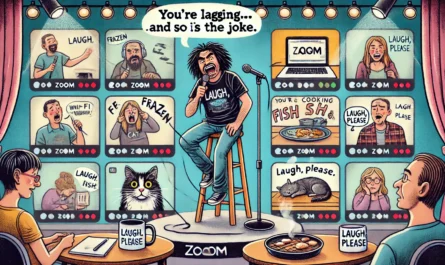
Zoom Comedy (Yes, It Still Exists)
Online shows have their own absurd context:
- You can’t hear the laughs.
- Someone’s kid is dancing behind them.
- Your punchline lands while the Wi-Fi freezes your face mid-blink.
How do you adapt?
- Slow down. Timing is different.
- Engage visually. Use expressions. Mug. Gesture.
- Name the weirdness. Call out your frozen screen. Laugh at the silence.
Self-awareness is 90% of surviving Zoom.
Adapting Doesn’t Mean Censoring – It Means Strategizing
Let’s be clear: adjusting for context isn’t “going soft.” It’s knowing when to deliver the hard stuff.
You don’t tell your darkest bit at a county fair in broad daylight next to the deep-fried Oreo truck.
But maybe you tell that bit:
- Slower.
- With more setup.
- In a way that lets the crowd know, “Yes, I’m saying something intense, but I know where I am.”
It’s not cowardice. It’s craft.
Good Comics Pivot. Great Comics Improvise. Legends Make the Room Theirs.
Ever seen a comic take a room that hated them and turn it?
They:
- Call it out: “Wow. I feel like I just bombed a wedding toast.”
- Drop the material and talk to the crowd.
- Switch tone, speed, style – without losing control.
That’s context mastery. That’s knowing the material serves the moment – not the other way around.
When to Stick to Your Guns (and When to Holster Them)
Some comics refuse to change – and sometimes that’s right.
If your act is about pushing buttons, then yes – push them. But own the risk.
If you bomb because you refused to adapt, at least bomb on purpose.
The worst comic is the one who doesn’t adapt and acts surprised it didn’t work.
The best comic knows: you can still do edgy material at a church fundraiser. You just have to smile when you do it.
Cultural Context: Know the Room Beyond the Room
Are you in:
- A blue city or a red town?
- A border state?
- A Native reservation?
- A gay bar?
- A prison?
The history, demographics, and politics of a place shape how comedy lands.
One man’s edgy bit is another man’s family trauma.
Do your research. Ask locals. Arrive early. Don’t assume “relatable” means universal.
Comics Who Mastered Context (and How They Did It)
- George Carlin: Adjusted his material throughout decades – from silly wordplay to anti-establishment rants, always knowing what the moment needed.
- Ali Wong: Plays clubs, colleges, arenas, and Netflix with different styles – but always her.
- Dave Chappelle: Can go from jokes about chicken sandwiches to philosophical breakdowns of American race relations – and knows when to go there.
They didn’t change who they were. They changed how they delivered.
Adapting Means Listening
Most comics listen for laughs. Great comics listen for everything else:
- Where the crowd sighs.
- When they lean back.
- When they get quiet for the wrong reason.
Adjust accordingly:
- Too aggressive? Soften.
- Too vague? Clarify.
- Too inside? Widen the reference.
Every show is a conversation. If you don’t listen, you’re just yelling into the void.
You Can’t Always Win the Room – But You Can Learn from It
Sometimes you try to adapt and still fail.
That’s okay.
The crowd might be wrong. The setup might be cursed. The room might be haunted by the ghost of a magician who bombed in 1986 and cursed all future comics.
But if you tried? If you read the room, shifted tone, acknowledged context, and still bombed?
That’s growth.
And growth is funny. Eventually.
Final Thought: Funny Is What Works Where You Are
Great comedy isn’t about sticking to your script. It’s about being present.
Adaptation is the art of listening, reading, and reshaping – without losing your voice.
Because the comic who can shift gears is the one who gets asked back. Not because they killed with every bit. But because they respected the moment.
And in stand-up, the moment is the only thing that’s real.
Originally posted 2025-05-20 15:01:24.