 by
by Physical Appeal: Why It’s Funnier Than You Think
Hot Comics Must Apologize First
by Alan Nafzger | ComedyWriter.info
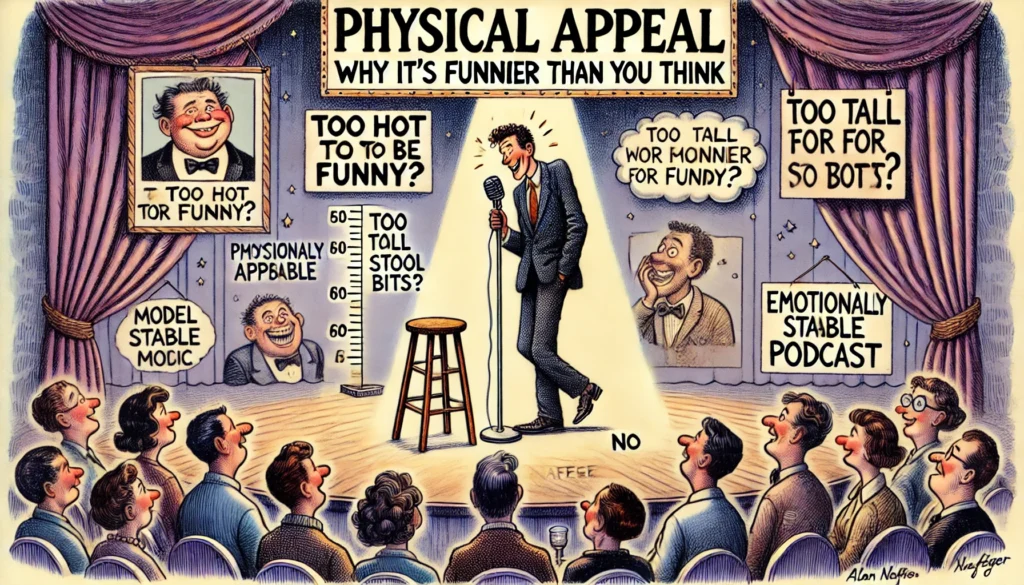
The American comedy stage is the only place on Earth where being too attractive can actually be a career hazard – right up there with being too tall for stool jokes or too emotionally stable to need a podcast. In stand-up, beauty isn’t just skin deep – it’s stage-deep. The way a comic looks affects not just how the audience reacts to them, but how they have to perform to earn those laughs.
So let’s break it down: Why are looks such a huge – and hilarious – part of comedy in America?
Because in stand-up, every molehill becomes a punchline. And your face? That’s the first setup.
The Unwritten Rule: Hot Comics Must Apologize First
In comedy, physical attractiveness is like wealth: if you have it, you better make it the butt of the joke, or the crowd will do it for you.
Ever wonder why Pete Davidson dresses like a meth lab tech who forgot laundry day? It’s not because he’s broke – it’s because hotness makes people suspicious. If you’re funny and attractive, Americans instinctively assume you’re faking one of them. So comics play defense.
- Iliza Shlesinger jokes about being the “hot girl at the club” so the audience doesn’t have to.
- Nikki Glaser jokes about sex addiction and poop – because if she didn’t, someone would just yell “Get off Instagram!”
- John Mulaney dresses like a 1962 accountant so we forget he has cheekbones.
Hot comics in America must perform humility to survive.
Ugly Is Relatable. Ugly Is Safe. Ugly Is Gold.
On the other end of the spectrum, physical awkwardness is a comedy buffet. There’s no end to the bits you can build off a weird nose, a gangly frame, or the fact that you look like a rejected Pixar character.
- Ron White looks like your divorced uncle who took up blues guitar and still calls it “the Facebook.”
- Jim Gaffigan leans into pale, pudgy dad energy so hard he basically turned into a mascot for sodium.
- Tig Notaro’s deadpan delivery matches her minimalist look – it’s anti-style as style.
These comics don’t run from their appearance. They weaponize it.
The Comedic Neutral: Bland-Looking Comics and the Blank Slate Advantage
Now, some comics fall into a fascinating category: the “face of the people.” They’re not ugly. They’re not hot. They’re just… there. And audiences love it.
These comics can play anything: the barista, the guy who just got dumped, the woman whose therapist is actively giving up. Their look doesn’t distract – it absorbs.
- Nate Bargatze looks like your co-worker who just learned what an HDMI cable is.
- Mike Birbiglia is the physical embodiment of “awkward but polite.”
- Taylor Tomlinson plays herself as “hot enough for prom, not hot enough to enjoy it.”
These comics blend in – and that gives them range.
Attractive Comics and the Burden of Proof
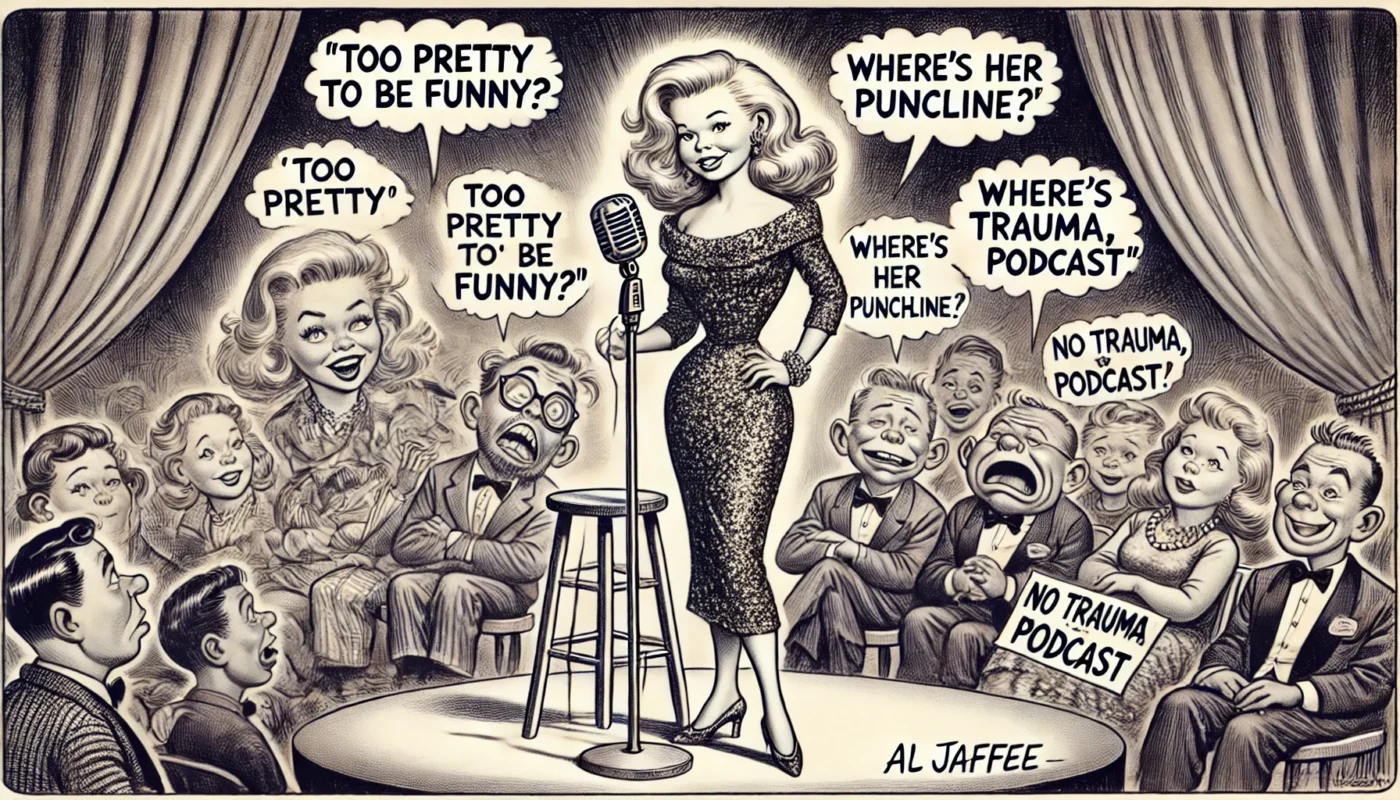
If you’re pretty and funny, Americans demand you prove the funny part. It’s almost punitive.
You have to be:
- Raunchier.
- More vulnerable.
- Louder.
- Faster.
It’s why Amy Schumer built her career on self-sabotage and sex jokes. It’s why Hasan Minhaj turned his good looks into dramatic monologues about racism and rejection. It’s why Jack Whitehall has to fall down at least once per set just to keep British audiences from throwing scones.
The prettier you are, the more the audience wants to see you fall – metaphorically or literally.
Hot, But Broken: The Modern Formula
The 2020s gave rise to a new breed of comic: hot, but shattered inside. This hybrid model is physically appealing and emotionally wrecked – and audiences eat it up like antidepressants in an election year.
These comics post hot selfies with captions like “I crave approval” or “My therapist is dead to me (RIP, Gary).” It’s a way of saying: “Yes, I have jaw structure. But I also have unresolved issues.”
This blend of lust and pity is powerful.
- Taylor Tomlinson: “I look like I have it together, but I believe horoscopes and eat frosting with a spoon.”
- Matt Rife: Abs onstage, but talks about being dumped like it’s his brand.
- Catherine Cohen: Performs glamour but bathes it in neurosis and glitter shame.
These comics seduce the audience, then confide in them – and the result is romanticized dysfunction, America’s favorite love language.
Comedic Beauty is Always Contextual
There are comedians who look objectively attractive – but are cast as ugly because of their environment.
Take Paul F. Tompkins. Is he hot? Not traditionally. But in a three-piece suit and a well-timed monologue about wine, he becomes the kind of hot that only exists in indie films and weird NPR fan fiction.
Same with Kate Berlant – she radiates “cool girl in a Wes Anderson movie who makes surreal art and refuses to text you back.” Not hot hot, but intellectually devastating.
This is contextual hotness, and it’s deadly onstage. Because it sneaks up on people.
When the Body is the Act
Some comics don’t just joke about how they look – they build entire acts around it.
- Gabriel Iglesias made “Fluffy” an empire.
- Bert Kreischer takes his shirt off like it’s a holy ritual.
- Fortune Feimster uses her Southern drawl and sturdy frame to turn brunch into a full-body bit.
Their bodies aren’t just part of the act – they are the act. Not in a gimmicky way, but in a “You can’t tell this joke unless you look like this” kind of way.
It’s comedy by silhouette.
The Crowd’s Reaction Is the Joke
Here’s a dirty secret: comics don’t always write their best bits – the audience does, with their eyes.
Sometimes, just walking onstage and looking a certain way triggers a laugh. Not a mean one. A recognition laugh. A “holy crap, this guy looks like an emotional support PE teacher” kind of laugh.
That’s not vanity – it’s data. The audience reacts to what it sees first. And good comics know how to milk that.
You can spend 15 hours writing a tight set about capitalism, or you can just say, “I know what I look like: if anxiety was a person.”
Boom. Kill shot.
Women Get the Short End of the High Heels
For female comics, physical appearance is a landmine field inside a bear trap on fire.
If you dress down, you’re “not trying hard enough.” Dress up? You’re “distracting.” Be hot? “Relying on looks.” Be plain? “Too niche.”
Comedians like Michelle Wolf, Amy Wong, and Rachel Feinstein all have to comment on their appearance just to clear the air before the audience starts forming conclusions on their own.
Even someone as surgically sharp as Joan Rivers had to turn her own plastic surgery into punchlines – or the audience would do it for her.
In comedy, being a woman means your body is always part of the script – whether you wrote it or not.
The “Gay Hot” vs. “Straight Hot” Problem
This one’s real: a comic who’s gay and hot is read differently than a straight hot comic.
Gay male comics like Joel Kim Booster or Matteo Lane often play their looks into the act – embracing it, sexualizing it, mocking it – and the audience eats it up.
But a straight hot guy? The audience assumes frat vibes, and he has to prove he’s not secretly the villain in a Netflix docuseries about financial scams.
The context of hotness changes how the material is heard. That’s why comedy is one of the few professions where your sexuality, weight, wardrobe, and dental plan all affect your delivery.
Plastic Surgery and the Punchline Economy
We’re entering a weird era in American comedy where some comics alter their appearance – and not for the better.
- “Funny nose job” comics.
- “Lip filler irony” comics.
- “BOTOX but make it punchline” comics.
Some of it is sincere. Some of it is performance art. But all of it gets talked about. And in 2025, attention is currency.
If you bomb a joke but the crowd is still staring at your eyebrows like they’ve been sculpted by an overambitious AI, guess what? That’s part of the act now.
Looks and Hecklers: A Special Relationship
If you’re hot onstage, hecklers will come for you like mosquitos in July.
- “Nice cheekbones, bro.”
- “Why you dressed like that if you’re gonna talk about feelings?”
- “Who brought Barbie?”
Hot comics must be ready to deflect. And when they do it well? It’s magic. Nothing kills heckle energy like a beautiful person clapping back with wit and venom.
It’s like watching a catfight where the cat also has a degree in literature.
Why Physical Appeal Is Funnier Than You Think
Because it isn’t supposed to matter. That’s the irony.
Comedy is supposedly the great equalizer. But the second someone walks onstage, the crowd makes a thousand judgments. And those judgments shape the laugh track before the first syllable.
Looks aren’t fair. But they’re funny – because they twist expectations, shape setups, and add color to every line.
When a hot person tells a joke about rejection, it hits different.
When an “ugly” person brags about confidence, the room laughs harder.
It’s not mean. It’s math.
Final Thought: Own the Frame or Be Framed
In stand-up, your physical appearance is the frame. You can ignore it – and let the crowd control the picture. Or you can own it – and use the frame to sell your art.
The best comics don’t fight how they look. They use it.
Because in America, the most powerful punchlines don’t come from your mouth. They come from the fact that the audience sees you – and still listens anyway.
Originally posted 2025-05-20 13:36:13.