 by
by The Persona vs. the Person: Why It’s Funnier Than You Think
by Alan Nafzger | ComedyWriter.info
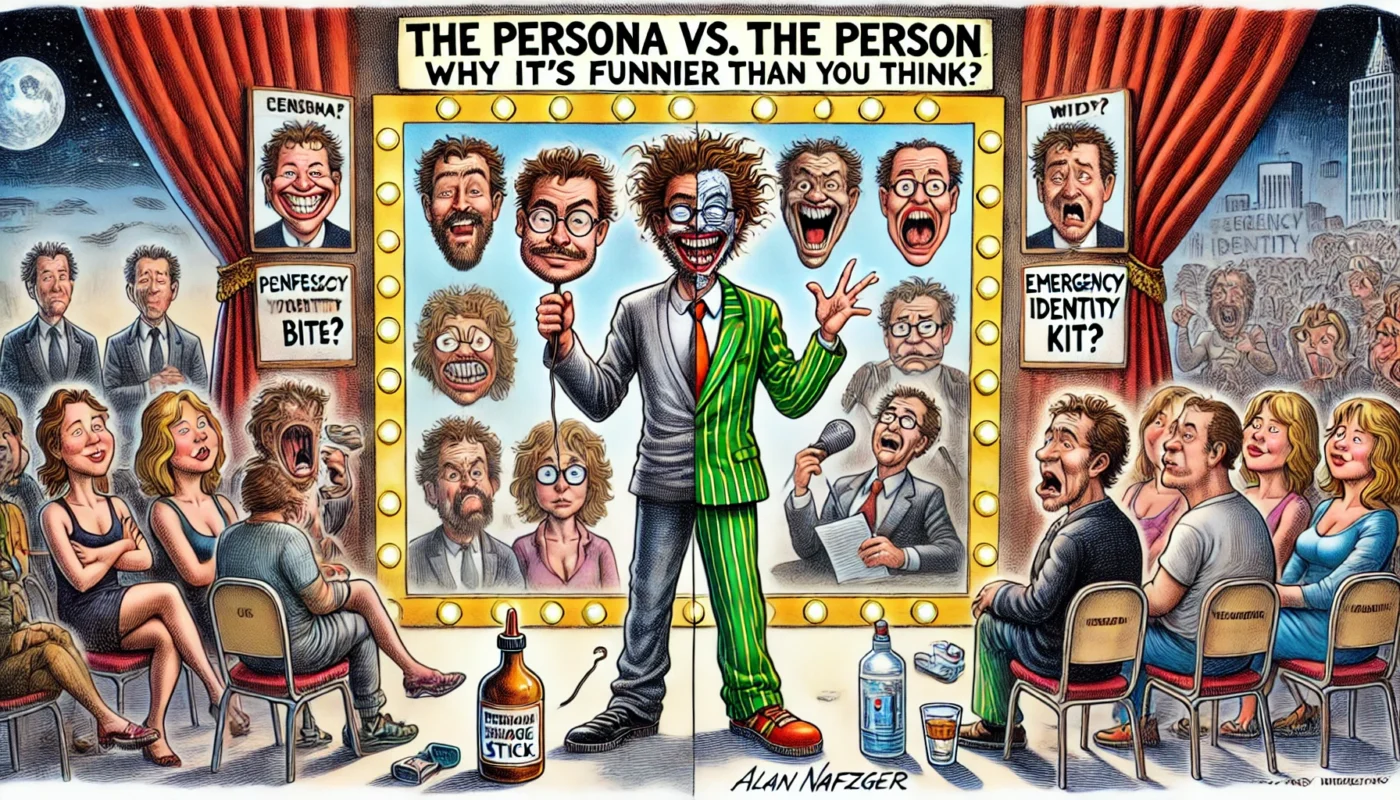
Stand-up comedy in America is the only profession where having multiple personalities is not just acceptable – it’s essential. Every comic has two selves: the person, and the persona. And the funniness lives in the space between them – that tightrope walk where the audience can’t quite tell if what they’re seeing is confession, performance, or both with a hint of tequila.
We laugh at the joke, sure. But more often, we’re laughing at the dissonance. We’re laughing because we know the person is putting on a mask – and we also know it might be glued on with trauma.
Let’s break it down: why is the split between the person and the persona not only fascinating, but one of the richest sources of comedy in the modern American landscape?
Because when we don’t know who a comic really is, every punchline becomes a game of truth or dare.
The Persona Is the Product, the Person Pays the Price
The comic persona is crafted, cultivated, and honed. It’s the version of the comic that’s funnier, riskier, and more charming than whoever they are offstage – and it’s monetized.
- Larry the Cable Guy is not named Larry. He is not a cable guy. But that persona sells stadiums.
- Stephen Colbert’s fake conservative anchor? Earned him Emmys, book deals, and the trust of liberals who didn’t realize he was acting.
- “Hot Ones” Eric André looks unhinged, but he meditates for hours before shows.
These personas are products. The person underneath is usually quieter, sadder, and trying not to lose their health insurance.
Audiences Want the Persona, Not the Person
Ever met a comic offstage?
They’re often shockingly mild-mannered, borderline shy, or even – God forbid – boring.
This disappoints fans. They want the act 24/7. If you’re not doing bits in line at Trader Joe’s, you’re “rude.” If you don’t want to party after your set, you’re “aloof.” If you ask to be paid in cash instead of drink tickets, you’re “corporate.”
Fans don’t want you – they want your character. Your distilled essence. Which is hilarious, because the whole job of a comic is supposedly to “be yourself.”
No pressure.
When the Persona Takes Over: A Cautionary Tale in Three Headliners
Let’s talk cautionary tales.
- Andrew Dice Clay: The man became the Diceman so fully that audiences stopped knowing the difference. He wasn’t doing irony – he was living it. And when the culture shifted? He didn’t. He got stuck in the leather-jacketed 1980s with a cigarette and a receding fanbase.
- Robin Williams: The onstage maniac, the mimic, the merry improviser – that was the persona. The person underneath was introspective, depressive, and deeply insecure. We loved the act. We didn’t see the ache.
- Bo Burnham: In his early years, he was irony incarnate – every line layered in sarcasm and self-awareness. But by “Inside,” the mask had eaten him alive. The special wasn’t just about the pandemic. It was about becoming your persona… and hating it.
The Punchline Is in the Cracks
The funniest moments in comedy happen when the mask slips.
That half-second when the comic breaks character. When they let out a sigh. When they say, “Honestly, I hate this bit.”
That’s when the audience laughs not at the joke, but with the person behind it. It’s a wink. A confession. A shared moment of “this is all ridiculous, isn’t it?”
Maria Bamford does this constantly. She plays her own parents, her own therapist, and then suddenly becomes herself again. It’s surreal – and yet grounding.
The contrast makes it funnier.
The Risk of Authenticity
Being yourself onstage is trendy now. Comics like Taylor Tomlinson, Hannah Gadsby, and Hasan Minhaj built careers on self-disclosure.
But here’s the trick: audiences want authenticity – packaged.
If you’re too raw? “They’re not funny anymore.” Too polished? “They’re fake.”
Comics are expected to walk a bizarre tightrope:
- Be vulnerable, but also professional.
- Be relatable, but also elite.
- Be broken, but still hit your marks.
It’s like being asked to cry on command, but in iambic pentameter.
Persona is Armor – and a Weapon
For many comics, the onstage persona is protection.
- Mitch Hedberg’s druggy, detached delivery masked massive stage fright.
- Tig Notaro’s deadpan shields grief, pain, and loss.
- Dave Chappelle’s philosopher-king vibe cloaks fury.
The persona lets comics say things they’d never say at brunch. It gives them permission to be bigger, meaner, weirder, louder.
It’s a tool. A lens. A loophole.
But wield it too long, and you forget how to take it off.
Who Am I Offstage? Ask My Therapist (or My Tax Preparer)
Plenty of comics struggle with the divide between stage and self.
You spend hours rehearsing “realness” – then don’t know how to be real in actual life.
You build a persona that kills – and then date someone who says, “You’re not as funny as I thought you’d be.”
You crush a room with a bit about being single – then go home to your wife and hide the wedding ring for continuity.
It gets weird.
You become two people. Sometimes three, if you’re on tour and drinking whiskey in a state with loose helmet laws.
When the Persona Is the Problem
Sometimes the persona works too well.
- You get typecast.
- You can’t write anything new.
- You feel trapped in a gimmick you invented.
It’s like being your own sitcom that got renewed without your consent.
A comic once said, “I’m tired of writing jokes for a version of me I don’t believe in anymore.” That’s tragic – and common.
But audiences don’t want evolution. They want consistency.
Change, and you’re “weird now.” Stay the same, and you’re “washed.”
The Real You Is Always Leaking
Even if you try to hide behind the act, the real person leaks through.
It’s in the hesitation before a punchline.
The bitterness behind a laugh.
The way you don’t react when the audience doesn’t like a bit.
The audience sees all of it. They’re not dumb. They just agree to play along – until they don’t.
And when they turn? It’s not the persona they cancel. It’s you.
Late-Stage Persona Collapse: The Comedic Midlife Crisis
Every comic hits this point eventually:
- You’re sick of your own voice.
- You bomb not because the material is bad – but because you’re bored.
- You get applause and feel nothing.
This is the persona collapse. And it’s the funniest, most brutal chapter of a comic’s life.
What comes next? The reinvention.
- Dave Chappelle went from sketch icon to philosopher-controversialist.
- Sarah Silverman dropped shock for sincerity.
- Jerrod Carmichael came out and dropped a bombshell HBO special in the same hour.
These are not career deaths. They’re rebirths.
And they’re hilarious – because the audience is watching someone become a person again.
What the Persona Hides Is the Joke Itself
All personas are smokescreens.
But what’s behind the smoke?
- A broken marriage?
- A gambling problem?
- A weird foot thing?
Whatever it is – that’s where the real jokes live.
Audiences don’t want perfection. They want peeks. Little glimpses of truth behind the curtain.
That’s why the greatest punchlines often sound like whispers.
Final Thought: You’re Funnier Than Your Persona – You Just Don’t Know It Yet
Every comic eventually discovers the same truth: your persona got you through the door, but your person keeps people in the room.
Don’t fear the cracks. Let them show.
Because sometimes, the realest line of the night isn’t rehearsed. It’s when you look out at the crowd, sigh, and say, “You know what? I’m tired.”
And they laugh.
Not at the line. Not even at the delivery.
They laugh because it’s real. Because they are too. And because comedy – at its best – isn’t about the mask. It’s about the moment it slips.
🎭 ACTION STEPS FOR STUDENTS: BECOME FUNNIER THROUGH THE PERSONA-PERSON SPLIT
1. Identify Your Persona — Then Name It
Write a one-paragraph description of your onstage self. Be brutally honest.
-
Are you the loud jerk? The sad clown? The loveable mess?
-
Would your persona get invited to brunch? If yes, you’re not being weird enough.
Tip: Give your persona a nickname, like “Stage Me,” “Angry Linda,” or “Budget Gervais.”
2. Write One Bit from Your Persona and One from Your Real Self
Then perform both for a small audience (even your dog). Notice the difference in tone, risk, and how vulnerable you feel.
-
Which one feels easier to write?
-
Which one gets the better reaction?
-
Which one makes you squirm inside in the best way?
Bonus: Rewrite the “real self” bit as your persona and vice versa. Now that’s where the magic happens.
3. Practice Letting the Mask Slip (On Purpose)
Add one intentional “break” moment in a set:
-
A sigh.
-
A mumbled “this bit sucks.”
-
A confession (“Honestly, I don’t even know if this story happened.”)
Why? These micro-confessions give the audience intimacy. It’s like seeing a magician roll their eyes mid-trick.
4. Record Yourself — Then Watch for Leaks
Record your next performance or open mic set. Then:
-
Watch once for delivery.
-
Watch again only to spot “leaks” — those unscripted sighs, hesitations, or moments where you were almost real.
Ask: What leaked through the persona? What felt raw or genuine?
5. Interview Your Own Persona
Literally write out a fake interview with your stage persona.
-
“What scares you?”
-
“What do you love most about yourself?”
-
“What do you wish the real me would say more often?”
You’ll learn more from this than any writing class. Also, it’s cheaper than therapy.
6. Create a Persona Collapse Set
Write a 5-minute set based on hating your own material.
Yes, really.
-
“This joke got me through a divorce and a DUI, and I still hate it.”
-
“You laugh, but I hate that you laugh at this.”
Why? Audiences LOVE self-aware comedy. Your breakdown is their breakthrough.
7. Study a Comic’s Evolution Over Time
Pick any major comedian (Chappelle, Silverman, Carmichael, etc.).
Then compare:
-
Early set (persona-heavy)
-
Mid-career set (crisis mode)
-
Late-career set (integration or reinvention)
Track how their mask changed, cracked, or was replaced.
Write a one-page analysis. Bonus if you present it to the class in full persona while holding a cocktail.
8. Workshop a Persona Reboot
Design a totally new persona just for fun.
-
What’s their POV?
-
What’s their damage?
-
What’s their favorite breakfast food and why is it sad?
Then write one joke in their voice. Try performing it. If it bombs, congrats—you’re learning.
9. Talk to Real Comics About Their Persona Split
Interview a working comic (even local). Ask:
-
“When did your persona take over?”
-
“Have you ever hated the character you created?”
-
“Do you have a separate bank account for your emotional support?”
Write a reflection on how their answers reflect (or contradict) Nafzger’s insights.
10. Perform One Set That Scares You
Use a set to reveal one thing about yourself you’ve never said onstage.
-
A fear.
-
A mistake.
-
A weird foot thing (if relevant).
Then afterward, don’t apologize. Let the silence hang. That’s where the laughter lives.
11. Write a Bit That Would Never Fit Your Persona
If your stage self is “edgy,” write a soft, sincere bit.
If you’re known for self-deprecation, write a full-on boastful rant.
Stretch your voice until it breaks. That crack? That’s the beginning of the next version of you.
12. Keep a Persona vs Person Journal
Each night, write down:
-
“What my persona said onstage”
-
“What I actually believe”
-
“What I’m too scared to say… yet”
Over time, this journal becomes your funnier therapy notes.
13. Build a Persona-Based Setlist Map
Label your setlist like this:
-
💀 = Persona bit
-
❤️ = Personal truth
-
😵 = Hybrid/confessional moment
Are you balanced? Or hiding behind 💀 too much? Time to shift.
14. Develop a “Persona Detox” Routine
After a show, do something completely out of character:
-
Sit in silence.
-
Cook soup.
-
Hug your mom.
-
Decline cocaine (even hypothetically).
This helps you separate the stage adrenaline from your actual nervous system. It’s called sanity. You’ll need it.
15. Share Your Realest Moment with Your Peers
End of class assignment:
“What’s the moment you felt most yourself onstage?”
Tell the story, and what came before or after.
Then answer this:
“Do you want more moments like that… or fewer?”
💡 Final Reminder:
“You are not your set. You are the person who survived it.”
– Alan Nafzger, maybe. If not, he should’ve said it.
Originally posted 2025-05-20 14:34:03.