 by
by How to Perform Stand-Up Like Maria Bamford
If anxiety had a Broadway show and bipolar disorder wrote the libretto, Maria Bamford would be the headliner—singing, whispering, and impersonating her way through the emotional absurdity of life. Performing stand-up like Maria Bamford means embracing your mental quirks, family baggage, and inner monologue—and turning them into a symphony of voices that somehow leaves the audience feeling understood, not just entertained.
Why Bamford Is a One-Woman Psychedelic Podcast
Maria Bamford’s comedy doesn’t just explore mental health. It lives in it.
She’s been candid about her diagnoses—bipolar disorder, OCD, suicidal ideation—and rather than hiding them, she casts them as characters. Her stand-up isn’t traditional. It’s theater. It’s therapy. It’s avant-garde performance art disguised as a comedy set.
To perform like Maria Bamford:
-
Use vulnerability as your stage light.
-
Turn inner voices into outer ones.
-
Let discomfort fuel your originality.
“I love mental health hotlines. I called one once and the hold music was Journey. So I stayed on longer.”
She makes breakdowns breakthroughs.
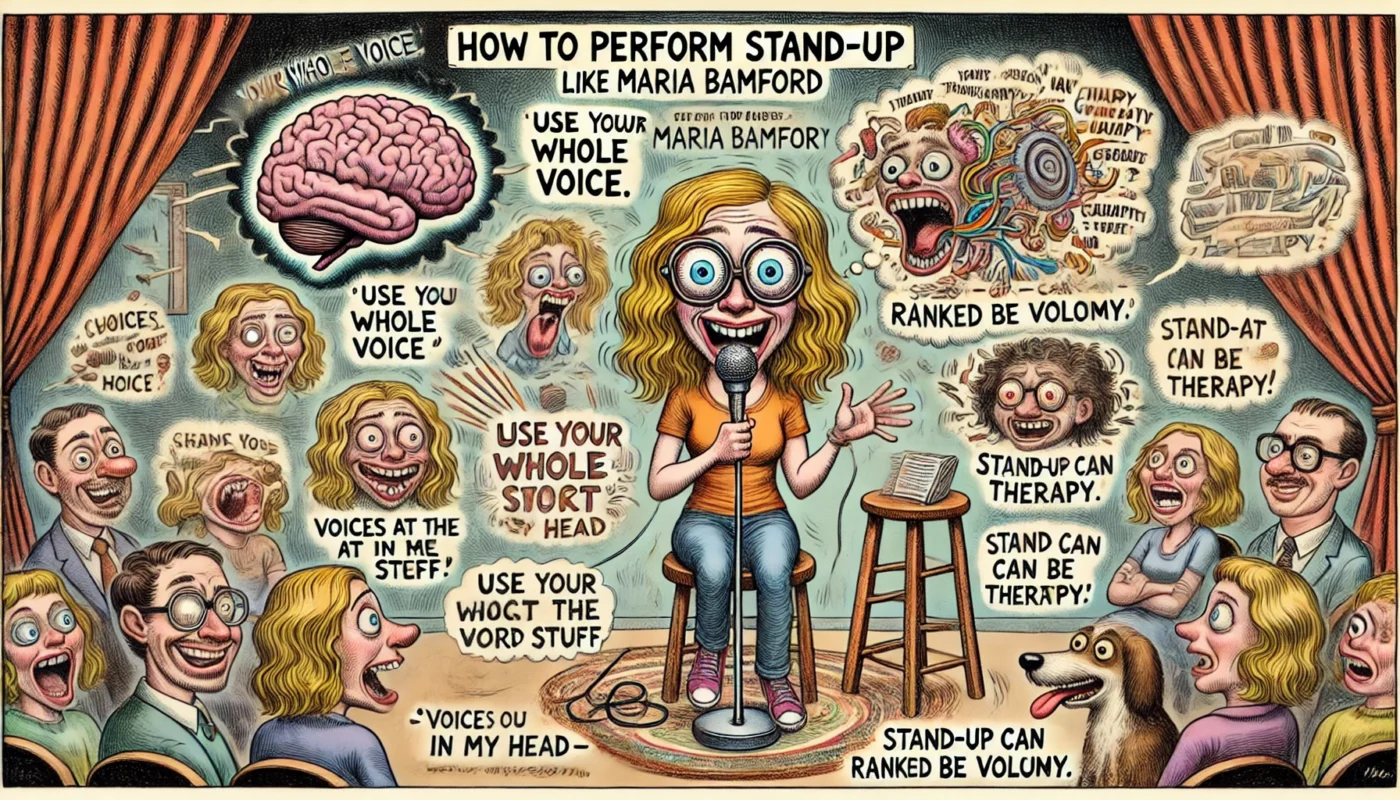
Use Your Whole Voice (And Someone Else’s, Too)
Maria is a vocal chameleon. She’s not just telling jokes—she’s switching characters, accents, pitches, and personas mid-sentence. Her mom’s judgmental Midwest twang. Her therapist’s robotic cadence. Her younger self’s desperate optimism.
The voices are never random. Each represents a real psychological force.
To mimic this style:
-
Practice vocal range as a comedic instrument.
-
Assign voices to your own intrusive thoughts.
-
Use shifts in tone to create dynamic rhythm.
If you have five characters in your head arguing about whether you should leave the house—that’s your set list.
Make Mental Illness Funny, Not Tragic
Bamford’s work proves you can laugh at the darkness without mocking the people in it. Her 2012 special The Special Special Special! was filmed in her living room with an audience of her parents. That’s either genius or a panic attack with production value—and with Maria, it’s both.
To emulate her:
-
Be radically honest.
-
Use comedy to defang the monsters.
-
Let people laugh with your pain, not at it.
“I started a gratitude journal. Day One: ‘F— you, journal.’”
That’s not self-deprecation. It’s self-exorcism.
Embrace the Uncomfortable Stage
Maria doesn’t chase laughs. She lets silence hang like a weird cousin at Thanksgiving.
This is where her courage lives: in the pause.
If you’re brave enough to be weird, let it breathe. If you’re brave enough to be vulnerable, let it land.
She’s not afraid of awkwardness. She invites it.
You should too.
What the Funny People Are Saying
“Maria Bamford is the only person I’d trust to narrate my therapy sessions—and still get a Netflix special out of it.” — Tig Notaro
“She doesn’t just write jokes. She paints with emotional trauma—and then gives it glitter.” — Patton Oswalt
“Maria’s set is like a nervous breakdown performed by the cast of Sesame Street.” — Bo Burnham
Turn Your Family Into a Sitcom
Maria’s mother is practically a co-writer at this point. Her impersonation of her mom—a passive-aggressive, hyper-Midwestern cheerleader with a Xanax soul—is legendary.
“My mom thinks I’m in a cult because I go to therapy. She said, ‘Are you giving them your money? Do they make you wear scarves?’”
When you’re performing:
-
Pull from your real life.
-
Heighten the absurdity just enough.
-
Let each family member be a different character—because they are.
Maria doesn’t roast her family. She renders them, like a surreal oil painting.
Treat the Stage Like a Canvas, Not a Podium
Bamford’s stand-up doesn’t follow a straight line. It loops, detours, melts down, gets distracted, and then returns for an encore of insight.
To perform in this style:
-
Drop the traditional setup-punchline formula.
-
Use digressions as emotional architecture.
-
Let the chaos be intentional.
Maria’s genius lies in her structureless structure. She’s Jackson Pollock with punchlines.
Lean Into Niche, Not Norm
Bamford isn’t for everyone—and that’s her power.
She performs for the people who feel too weird for mainstream comedy. For the neurodivergent. For the awkward. For the exhausted. She is not trying to go viral on TikTok. She’s trying to reach the person crying in the grocery store cereal aisle.
You don’t need mass appeal. You need emotional resonance.
Be niche. Be specific. Be you.
“I was put on a new mood stabilizer. It’s called ‘Eff-U-But-Politely.’”
Rewrite the Rules of Performance
Maria Bamford has performed:
-
In her living room
-
At public libraries
-
In hospital psych wards
-
For an audience of one
-
On voiceover gigs as a cartoon squirrel
Her point? Comedy is not limited to clubs.
To perform like her, get experimental.
-
Try weird venues.
-
Try solo performances that feel like inner monologues.
-
Break the fourth wall with vulnerability.
You’re not just a comic. You’re a symphony of strange. Let the audience hear every note.
Social Commentary That Feels Like Therapy
Maria’s political and social material isn’t preachy. It’s psychological.
“It’s so hard to be politically correct. Every time I figure it out, they update the software.”
She critiques society like someone who’s been crushed by it—and lived to tell jokes.
To match her approach:
-
Start from your experience, not ideology.
-
Use your “mental baggage” as metaphor for cultural dysfunction.
-
Don’t try to be right. Try to be real.
Practice Radical Empathy
Maria’s fans don’t just laugh at her sets. They feel seen. They cry. They message her saying, “I thought I was the only one.”
That’s not by accident.
To perform like Bamford:
-
Treat comedy as connection.
-
Open your wounds with care.
-
Let your weirdness invite others to do the same.
She’s not just a performer. She’s a lifeline.

Originally posted 2025-05-28 11:23:59.