 by
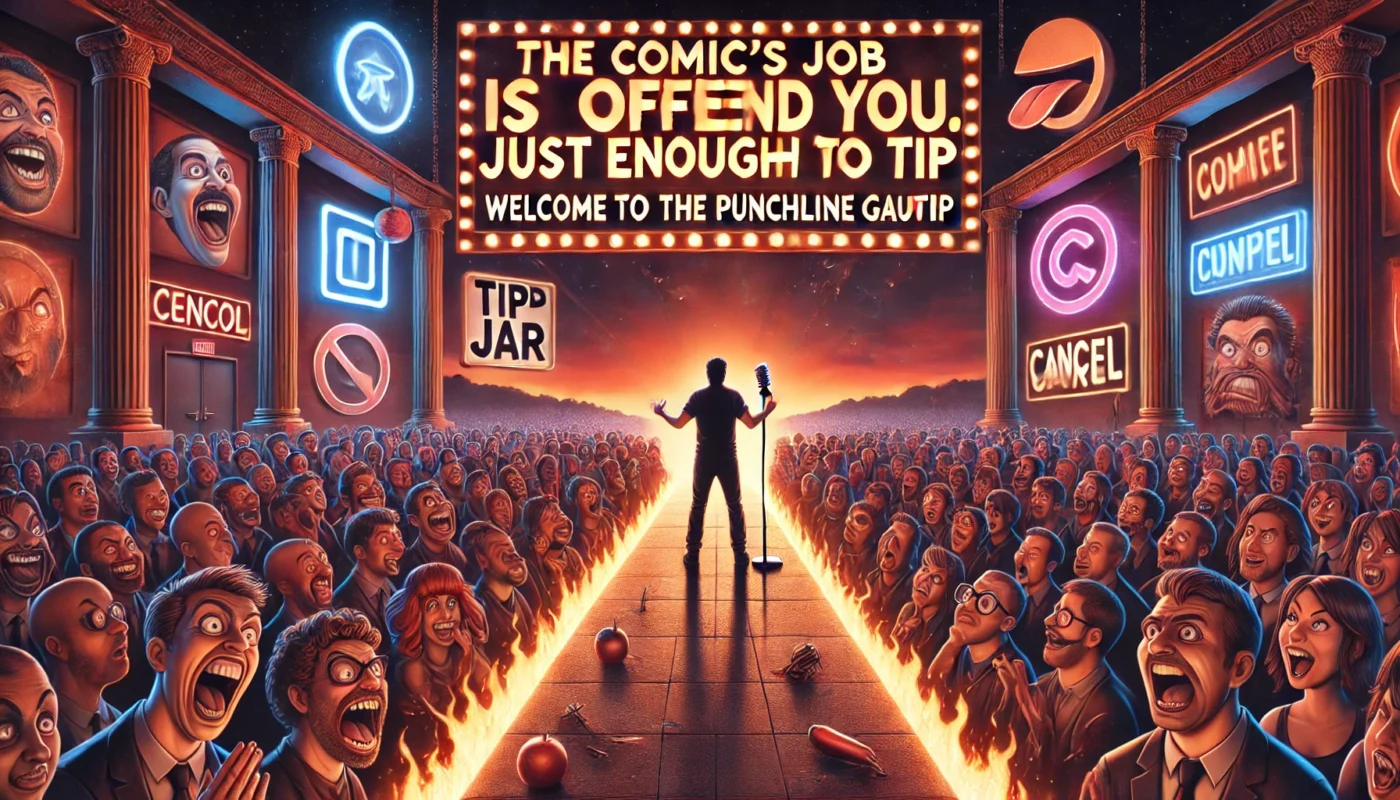
by The Comic’s Job Is to Offend You (Just Enough to Tip)
Welcome to the Punchline Gauntlet
Let’s be honest: not all comedy is cute. Some of it is abrasive, sweaty, loud, and smells like cigarettes and daddy issues. But that’s not a bug — it’s a feature. Challenging the audience isn’t an accident in stand-up comedy; it’s an ancient ritual, like bear baiting or Thanksgiving with in-laws.
The American stand-up comic isn’t a clown or a clownfish. They’re a minesweeper with a microphone, walking across taboo topics like it’s a floor made of expired Twitter policies. The best ones make you laugh right before you realize you should probably be mad. Then you tip.
Lenny Bruce Died So Louis C.K. Could Bomb Gracefully
We owe this particular style of comic confrontation to Lenny Bruce, the patron saint of getting arrested mid-punchline. Bruce didn’t do bits — he performed verbal knife fights with audiences who often didn’t even know the rules of engagement.
His act was half confession, half provocation. He didn’t tell jokes so much as challenge the concept of “joke.” And America, god bless it, responded by trying to get him banned, arrested, or at least labeled “unfit for polite dinner parties.”
Cut to: modern comics like Dave Chappelle, who walk the same line — balancing insight, provocation, and cancellation like a circus bear on an HR compliance wire.
Trigger Warning: That’s the Show
There’s a weird expectation now that comedy be safe. Which is hilarious, because comedy has never been safe. It was born in vaudeville back alleys, not TED Talks. It matured in late-night diners, dive bars, and that weird uncle’s garage who “used to open for Carrot Top.”
The best comics don’t avoid offense — they marshal it. They point it at power, hypocrisy, or your grandma’s belief that oat milk is a gateway drug. They challenge assumptions and ask dangerous questions like:
-
“Why do we still tip?”
-
“What does masculinity mean after Axe body spray?”
-
“Is ‘live, laugh, love’ a threat?”
Bill Hicks Wanted You Uncomfortable (and High)
Bill Hicks once said that the audience’s job was not to clap but to “rethink their entire existence.” He’d walk onstage, light a cigarette, and drop cosmic cynicism like a chainsmoking oracle in a Led Zeppelin T-shirt.
Hicks didn’t care if you liked him. He cared if your soul flinched. His jokes about religion, war, and American consumerism weren’t designed to sell merch — they were emotional barbed wire, separating the thinkers from the brunchers.
Amy Schumer Weaponized Relatability
Then there are comics who challenge the audience by flipping the cultural mirror — and then smashing it with their uterus. Amy Schumer’s early sets weren’t just about dating and body image. They were psychological home invasions. She didn’t just tell stories — she dared you to relate.
By mocking hookup culture, gender norms, and bodily shame, Schumer invited audiences to confront their own biases while laughing through their discomfort. The joke wasn’t always funny — but it was undeniably true.
Taboo is the New Tourist Trap
Once upon a time, saying “sex” onstage was revolutionary. Now, comics have to dig deeper: “sex with context,” “sex with consequences,” “sex that ends in someone crying next to a dead phone.”
Topics that were once taboo — like interracial dating, addiction, or therapy — have been monetized. The new taboos are weirder:
-
Taking a break from social media.
-
Voting without a bumper sticker.
-
Liking Friends unironically.
Modern comics challenge not just what we talk about, but how we process identity, authenticity, and algorithmic approval.
Hannah Gadsby Broke the Show in Half — and Then Rebuilt It
In Nanette, Hannah Gadsby rejected the very premise of stand-up structure. She walked into a Netflix special and said, “I’m not doing jokes anymore,” and half the audience went, “Wait, what? Is this therapy? Should I Venmo you?”
But the confrontation worked. Gadsby turned the comedy stage into a platform for rage, trauma, and inversion. Was it divisive? Yes. Was it stand-up? Debatable. Was it art that punched up, punched through, and left viewers shattered?
Absolutely.
Patton Oswalt: The Gentle Provoker
Not all challenging comics scream at the audience. Some, like Patton Oswalt, gently usher them into existential crisis with the tone of a substitute teacher who just realized the world is ending.
He’ll start with something soft — a bit about Hot Pockets — and by the end, you’re reckoning with fascism, death, and the ethics of liking The Goonies as an adult. He’s not confrontational. He’s subversively disturbing — the guy who makes you laugh while wondering if you’re part of the problem.
The Audience Isn’t Always Right
Comedy isn’t Yelp. The customer isn’t always right. Sometimes the customer is racist, loud, or thinks a joke about dolphin therapy is “too political.”
Challenging comics push back. They don’t pander. They remind you that laughter isn’t owed — it’s earned. When a comic drops a controversial punchline and the audience recoils, that’s not failure. That’s reconnaissance. It tells the comic where the real work begins.
When Silence Is the Funniest Response
A good comic knows when a room is dead. A great comic knows how to use that silence. When the audience gasps instead of laughs? That’s power. That’s presence. That’s knowing you’ve hit a nerve with surgical precision.
Doug Stanhope has built a career on this. His jokes about suicide, addiction, and the failures of modern medicine aren’t light. They’re dark, heavy, and laced with venom — but they’re honest. The silence that follows isn’t discomfort — it’s comprehension.
Cancel Culture vs. Accountability: The Comic’s Dilemma
Let’s address the peanut gallery: “You can’t say anything anymore!”
You can. But you might face consequences, especially if you confuse challenging comedy with just being a lazy bigot.
True challengers aren’t shock-jocks. They’re scalpel-wielders. They dissect society, identity, hypocrisy — and yes, sometimes race and gender — but with purpose, not just for provocation.
Being called out isn’t the death of comedy. It’s part of the ecosystem. The crowd speaks back. That’s what makes it live. That’s what makes it real.
What the Funny People Are Saying
“Comedy is there to test the limits of your comfort — not your intelligence.” — Michelle Wolf
“If nobody gets mad, it probably wasn’t important.” — Chris Rock
“I’m not here to make you feel good. I’m here to make you feel. And then maybe laugh if you can handle it.” — Bill Burr
“Some people say ‘go woke, go broke.’ I say ‘go lazy, go irrelevant.’” — W. Kamau Bell
“If your comedy only works in a frat house, maybe it belongs in one.” — Tig Notaro
How to Challenge Without Being a Jackass
Let’s break it down. If you want to challenge your audience but avoid sounding like an alt-right barista who just discovered Reddit:
-
Have a point.
-
Know your audience.
-
Don’t punch down.
-
Write better jokes.
Simple.
Laughter Is Not the Only Goal — Sometimes It’s a Trojan Horse
The laugh is the trojan horse. Inside it is a small army of ideas. A good comic rides it into the fortress of your apathy and unleashes something sharp, unsettling, and maybe even healing.
Challenging comics aren’t trying to hurt you. They’re trying to wake you up. They’re the last group of people still yelling “The emperor has no clothes!” while also selling T-shirts that say it.
That’s the contradiction. That’s the craft.
That’s the job.
Originally posted 2025-05-16 08:27:40.