 by
by They’re Just Like Us (But Funnier): The Cult of the Relatable Comics
by Alan Nafzger | ComedyWriter.info
It starts innocently enough.
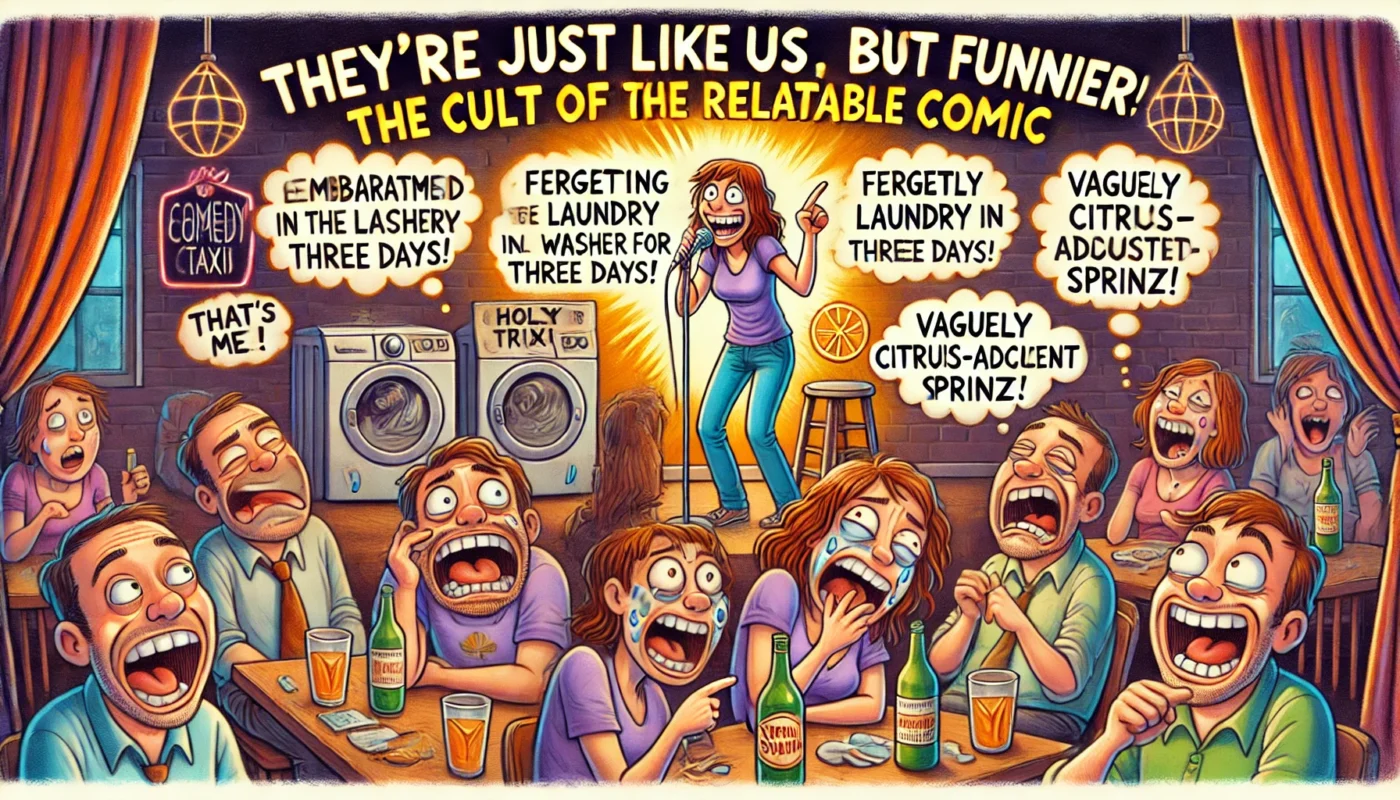
You’re sitting at a comedy show, sipping something overpriced and vaguely citrus-adjacent, when the comic walks onstage and says:
“You ever forget your laundry in the washer for three days and then pretend that mildew smell is just your personality now?”
The crowd erupts.
Why?
Because that’s you. That’s them. That’s us – but funnier.
Welcome to the church of relatability, where the holy trinity is:
- Minor personal failure
- Unflattering self-awareness
- Comforting punchline
In today’s American stand-up landscape, being relatable is currency. And some comics spend it like it’s stimulus season.
Let’s explore why audiences love comedians who feel like their weirdest friend, how relatability became a brand, and what happens when being “just like us” gets a little too accurate.
Why Relatable Kills in the Age of Overwhelm
Modern audiences aren’t looking for Greek philosophers or moral authorities. They’re looking for someone who:
- Eats Cheez-Its for dinner.
- Accidentally sexted their mom.
- Has yelled “YOU’RE WELCOME!” at an automatic paper towel dispenser.
Relatable comics don’t present truth. They present mirrors.
And we laugh – not at the joke – but at the recognition.
“Oh my god, I thought I was the only one who cries while folding fitted sheets.”
The Psychology of “Oh My God, Same” Laughs
A “same” laugh is different from a traditional laugh.
Traditional laugh:
- Set up
- Misdirection
- Punchline
- Release
“Same” laugh:
- Premise
- Immediate identification
- Nervous group chuckle
- Emotional validation
It’s less about wit and more about tribal bonding.
Relatable comedy says:
“You’re not crazy. We’re all like this. Here’s proof in joke form.”
The Rise of the Relatability Industrial Complex
Instagram. TikTok. Netflix. Every algorithm favors comics who:
- Make eye contact.
- Talk about everyday nonsense.
- Mention roommates, food delivery, or minor mental illness in the first 30 seconds.
And so the market floods with:
- “Anxiety girl.”
- “Lazy guy who’s proud of it.”
- “Millennial mom who hates gluten and her kids.”
Each persona is carefully crafted to be the audience’s therapist and roommate in one.
Comics Who Weaponized the “Just Like You” Energy
- Taylor Tomlinson: Catholic guilt, therapy, self-sabotage – delivered with prom queen poise.
- Hasan Minhaj: Family pressure, identity crises, tech-savvy stage presence – an everyman with angles.
- Jim Gaffigan: Food, parenting, self-loathing – looks like your friend’s exhausted dad and acts like he just found out cheese is a tax write-off.
These comics aren’t being basic – they’re being precise.
Their relatability is studied. Refined. It’s chemistry class for shared trauma.
Why Relatable Is Funnier Than “Smart”
Smart jokes impress us.
Relatable jokes include us.
You don’t need to Google them. You don’t need a cultural studies degree.
You just need to:
- Have dated someone emotionally unavailable
- Owned a faulty printer
- Been sad in a Walmart parking lot
Relatable jokes aren’t “better” – they’re stickier. They replay in your head when your Wi-Fi drops mid-Zoom or you get ghosted by someone named Chad.
The Formula: Misery + Specificity = Shared Joy
Example:
“I didn’t just get dumped. I got ghosted mid-date. Like, he left for the bathroom and two years later I saw him in a Subaru commercial.”
The specifics are absurd – but the emotion is real.
Relatable comics take:
- Small moments
- Add weird flourishes
- Deliver with exhausted pride
They don’t brag about their life. They leak it.
And we laugh because it’s uglier than we’d admit – but funnier than we thought.
The Trap of Performing “Relatable” Instead of Being Relatable
Eventually, audiences catch on to fake relatable comics.
The signs:
- “You ever do laundry in the bathtub because capitalism?”
- “Who else forgot to pay rent for four months because they’re vibing?”
- “LOL I’m so poor I bought air.”
When relatability becomes forced, it turns into pandering.
The crowd starts thinking:
“Are you actually broke or just cosplay-broke for clicks?”
True relatability requires vulnerability – not just mentioning sadness, but feeling it aloud.
What Happens When a Relatable Comic Gets Famous
It gets weird.
They still say:
- “I’m so awkward.”
But now they’re wearing $800 sneakers and filming their special from a rooftop sushi bar.
The tension is real.
Fans ask:
“Can someone who flies first class still joke about DoorDash fees?”
The best comics acknowledge this tension:
- They self-roast.
- They add perspective.
- They punch up at their own success.
The worst ones pretend nothing’s changed. And that’s when relatability turns into delusion.
Relatable Comedy Isn’t Soft – It’s Subversive
Relatable doesn’t mean safe.
Some of the sharpest social commentary sneaks in through:
- Relationship stories
- Family dysfunction
- Personal failure
Audiences come for the shared pain. They stay for the hidden wisdom.
And the best comics know how to turn “I have depression” into a Trojan horse for dismantling the American health care system.
When Relatable Meets Risky – That’s Where the Real Laughs Live
A comic says:
“Sometimes I cry in my car because I didn’t get enough likes on a post about my dog’s death.”
It’s absurd. Vulnerable. Embarrassing. Honest.
And that intersection?That’s gold.
Because the laugh that erupts isn’t just a giggle – it’s a full-body exorcism of shared shame.
Relatable Isn’t About Content – It’s About Tone
You can make anything relatable if the tone is right.
Even:
- Space travel
- Horse ownership
- Collecting 19th-century spoons
If you present it with:
- Insecurity
- Curiosity
- Chaos energy
…the audience will connect.
It’s not what you say. It’s how you confess it.
Final Thought: We Like Comics Who Sound Like Us – But Sharper
Relatable comics are our avatars. They speak our problems back to us, but funnier, faster, and with better posture.
They aren’t better than us. They’re us, filtered through a mic and a few thousand repetitions.
And when they get it right?
We laugh not just at the joke – but at the feeling that, for a moment, someone understands us without needing to make eye contact.
And that might be the most comforting punchline of all.
Originally posted 2025-05-20 15:54:13.