 by
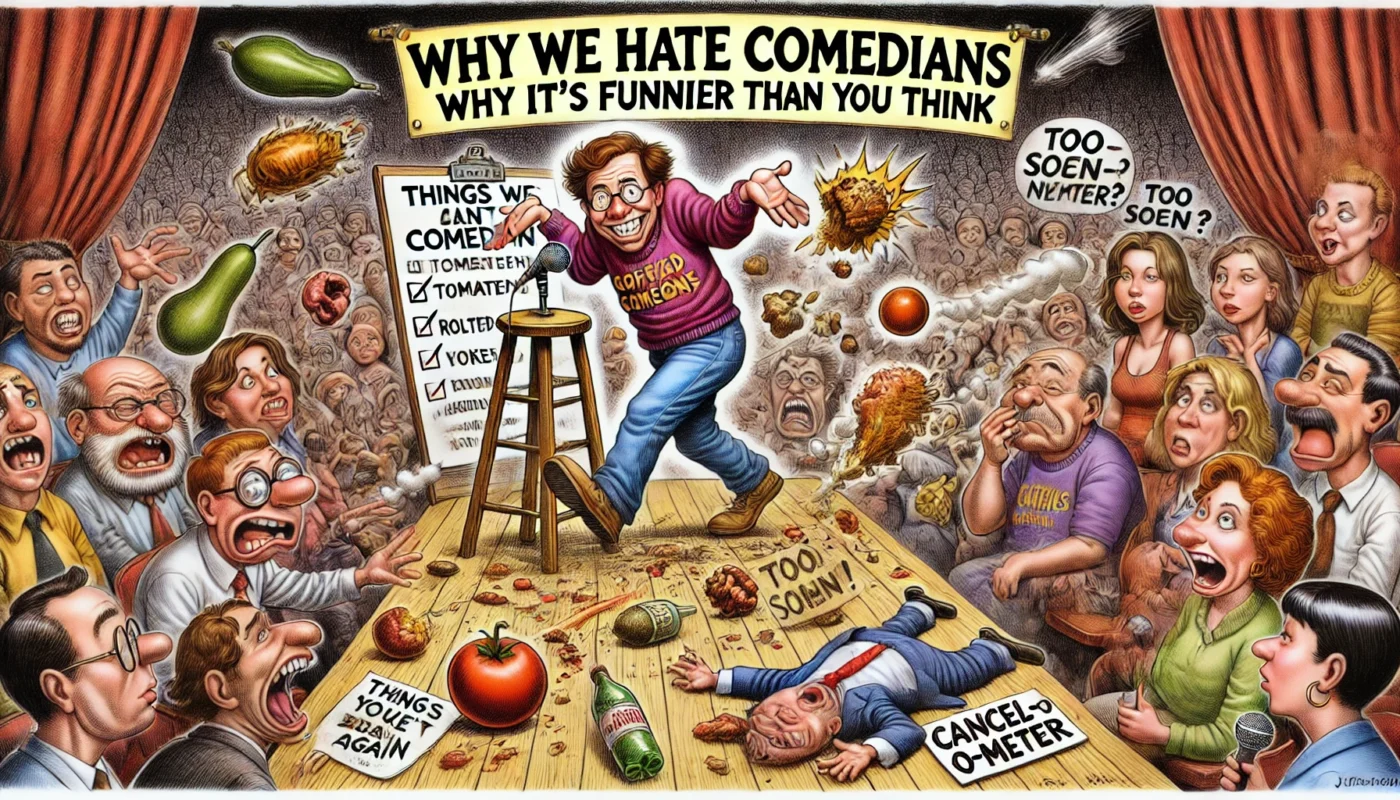
by Why We Hate Comedians: Why It’s Funnier Than You Think
by Alan Nafzger | ComedyWriter.info
Let’s get one thing straight: Americans don’t just love comedians. We love to turn on them. The same crowd that once shouted “Legend!” can become a pack of Yelp reviewers with torches the moment a punchline offends, a tweet resurfaces, or someone just gets too successful.
There’s a secret, rarely spoken truth in stand-up: being liked is dangerous – because once the audience feels they know you, they feel entitled to judge you. That’s why our laughter is always just one Netflix special away from booing. And oddly enough, that hate? That backlash? That simmering collective betrayal?
It’s funny.
Because in comedy, being hated – properly, publicly, passionately hated – often makes the show even better.
We Hate When They Get Rich
The fastest way to lose America’s love as a comic? Get wealthy.
- Dave Chappelle built a cult following, walked away from $50 million, then returned with $60 million from Netflix… and became a target.
- Kevin Hart turned every appearance into a brand extension, and half the internet now refers to him as “Kevin Corporate.”
- Ellen DeGeneres was beloved until she dared to be rich, dance, and – worse – act like a boss.
The audience wants authenticity, but only if it’s broke authenticity. Once you’re successful, the crowd begins to suspect you might not really be one of them anymore – even if your jokes still slap.
Fame Is the Setup, Hatred Is the Punchline
In the U.S., we treat success like a trick ending. “Oh, you made it? Cool. Now fall.”
It’s not unique to comedy. We do this to pop stars, athletes, and politicians. But comics get it the worst. Why? Because we assume they’re telling us the truth. So when the truth gets inconvenient – or, worse, unfunny – we punish them.
- John Mulaney: too clean-cut? Now he’s a scandal.
- Amy Schumer: too feminist? Now she’s “polarizing.”
- Louis C.K.: let’s not even.
Audiences will forgive a lot, but they won’t forgive changing without their consent. You were our guy – how dare you evolve?
Backlash is the New Badge of Honor
Let’s be real: in 2025, if you’re not hated by someone, are you even a comic?
In today’s media environment, outrage equals relevance. Getting “cancelled” is practically part of the PR cycle. If no one’s writing an angry op-ed about you, you’re probably still doing open mics in Gary, Indiana.
Some comics – looking at you, Bill Maher – even count on the hate. They build material around it, weaving public scorn into tight 5-minute blocks of self-aware bitterness.
It’s like a roast, except the audience doesn’t know they’re participating.
We Hate Who We Used to Love – Especially If They’re Still Good
The tragicomic paradox of fame: the better you are, the more likely people will get tired of you.
- Bo Burnham: hailed as a genius. Now accused of being too introspective, too artsy, too… tall?
- Sarah Silverman: revolutionary at first. Now “predictable” to the TikTok crowd.
- Hasan Minhaj: called “the new Jon Stewart” until he became… well, not Jon Stewart.
Fans love to be the first to discover someone. But the second everyone else is laughing too? Suddenly you’re mainstream, and that’s unforgivable.
Funny People Are Held to Serious Standards
Here’s a fun twist: comedians are expected to tell the truth, push boundaries, and “say what we’re all thinking”… until it’s something we don’t agree with.
That’s when the knives come out.
We demand truth-telling – but only the kind we like. That’s why Ricky Gervais can mock celebrities at the Golden Globes and get a standing ovation one year, then Twitter crucifixion the next.
Audiences want raw honesty, but also immaculate politics. Dirty jokes, but only from clean sources. Guts, but no discomfort. It’s the emotional gluten-free diet of comedy: all the flavor, none of the offense.
We Hate Relatability When It’s Marketed
You know what really gets under people’s skin?
When comedians start branding their personalities.
Relatable becomes “manufactured.” Vulnerability becomes “manipulation.” Suddenly, that heartwarming Instagram reel about social anxiety gets dissected like it’s a Pentagon memo.
- “Oh, they’re just saying that to get likes.”
- “They’re not really like that.”
- “I liked them better when they were messy.”
Ironically, comics who get too polished – too strategic – start to resemble politicians. And Americans hate nothing more than a funny politician.
We Hate What We Can’t Cancel
Some comics have escaped our wrath. Somehow.
Norm Macdonald said awful things and still died a hero. Joan Rivers insulted everyone and got a red carpet tribute. George Carlin became more beloved posthumously.
Why? Because they were consistent. The audience knew what they stood for. There were no surprises.
The hate flows when we feel betrayed – when the public persona no longer matches the punchline. When the vulnerability starts to look like marketing. Or when the joke turns into a TED Talk about your divorce lawyer’s podcast.
We Hate Comedians Who Try Too Hard to Be Nice
Ever seen a comedian walk onstage and immediately try to charm the crowd?
“I’m so grateful to be here! What a beautiful town! You guys have the best airport Chili’s!”
It’s unbearable.
Audiences smell neediness like sharks smell blood. In comedy, desperation isn’t charming – it’s terrifying. The crowd doesn’t want your friendship. They want your guts, your trauma, your best five minutes on sex and traffic.
If you come across too polished, too sweet, too emotionally stable – we hate it.
Give us dysfunction. Give us shame. Give us someone who needs therapy more than we do.
Hating the Comic Becomes Part of the Joke
Here’s where things get meta: sometimes, the hatred itself becomes the act.
- Anthony Jeselnik built his entire persona around being despised.
- Andrew Dice Clay ran on audience revulsion.
- Jeff Ross looks like he eats hecklers for breakfast.
The audience knows they’re supposed to be offended – and that tension makes it funnier. It’s the world’s most uncomfortable handshake.
This is why roasts work. We want to see boundaries tested – and comedians punished for testing them.
The Internet Makes Hating Easier Than Laughing
Back in the day, if you didn’t like a comic, you just didn’t buy a ticket.
Now, you can:
- Comment “cringe” on their YouTube.
- Tweet a think piece about their cardigan.
- Start a subreddit dedicated to analyzing why they peaked in 2017.
In fact, some people get more enjoyment from hating a comedian than they do from actually consuming their work. The hate becomes the hobby.
And weirdly? That hate drives engagement. Which drives ticket sales. Which keeps the comic employed.
We’re in a feedback loop of outrage-fueled capitalism – and we still won’t log off.
We Hate Comedians Because They Get Away With It
Deep down, there’s resentment at the fact that comedians get to say what the rest of us can’t.
They say the wrong thing – and get applause.
We say the wrong thing – and get HR training.
That freedom, that power, makes people uneasy. And when the comedian isn’t “on our side” anymore? The audience wants to take that power back.
It’s not really about the joke. It’s about control.
Laughter and Loathing Are Siblings
If you think hatred and laughter are opposites, you’ve never seen an audience lose it over a comic bombing. That mix of tension, embarrassment, and Schadenfreude?
That’s delicious.
We love to cringe. We love to mock. We love to share clips of a celebrity doing crowd work and getting heckled by someone with a karaoke mic and a vendetta.
Our relationship with comedians is inherently unstable. And that’s why it’s funny. Because every laugh is also a risk.
And every risk? One step closer to hate.
Final Thought: Hate is Just Another Kind of Laugh
So why do we hate comedians? Because they’re too rich. Too loud. Too vulnerable. Too polished. Too ugly. Too hot. Too political. Not political enough. Not like they used to be. Too much like they used to be.
But underneath all of it?
It’s because they make us feel something.
Hate, in comedy, is just another emotional engagement. Another punchline. Another audience reaction.
We might not clap. We might not cheer. We might not even laugh.
But we’re watching. And in comedy – that’s what counts.
Originally posted 2025-05-20 13:22:07.


