 by
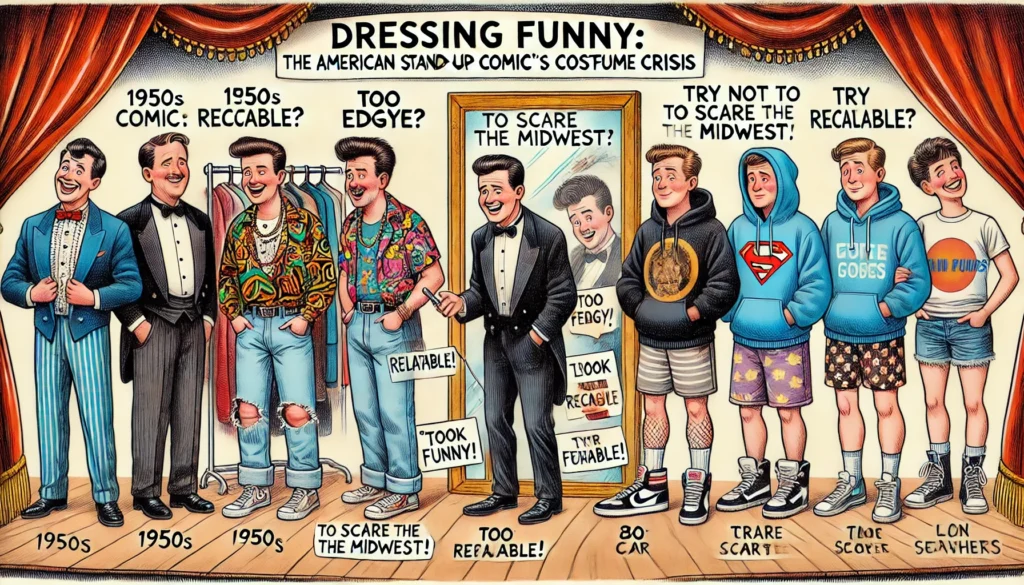
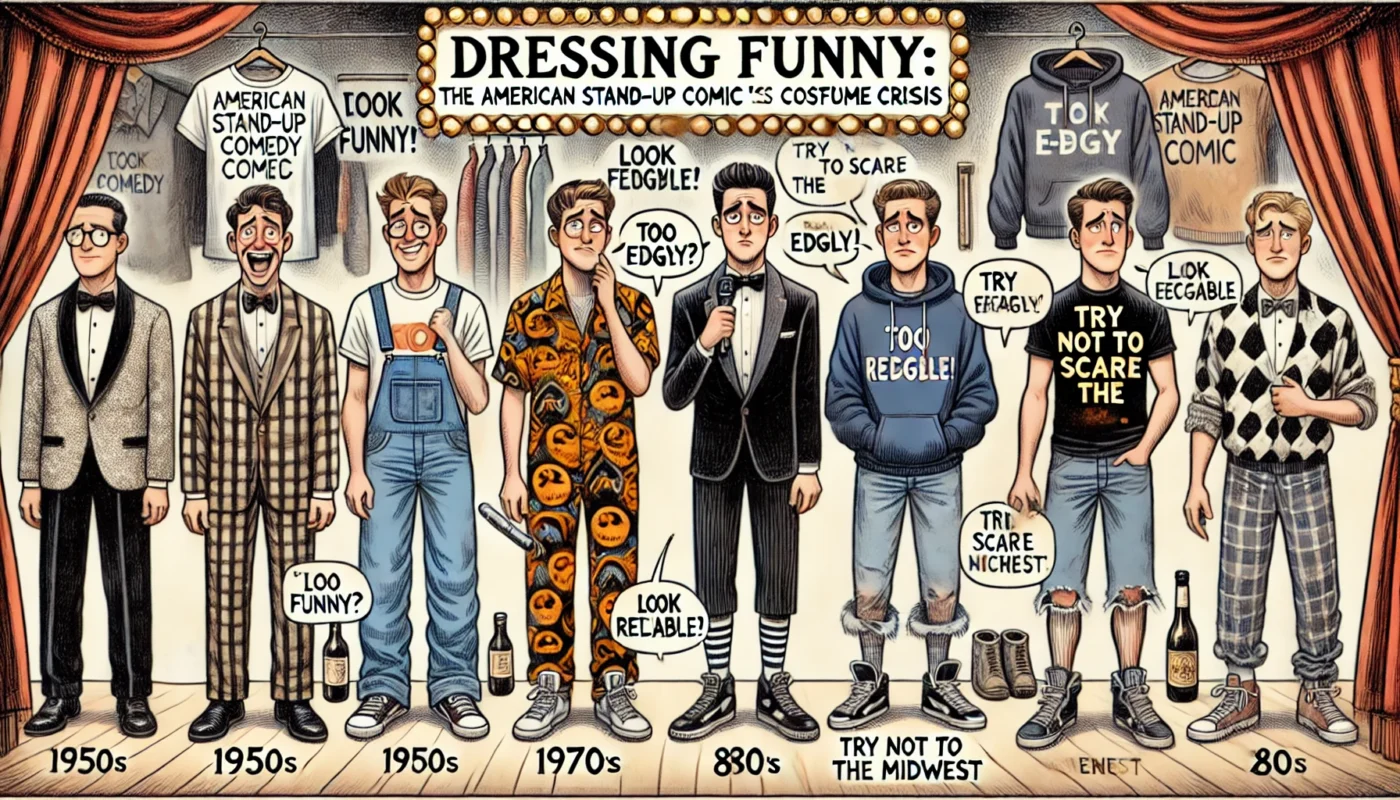
by Dressing Funny: The American Stand-Up Comic’s Costume Crisis
How Sneakers, T-Shirts, and Attitude Built a Nation of Laughs
In the land of the free and the home of the brave, it’s not just the jokes that matter—it’s the shoes you tell them in. British comics may ramble on about “trainers” and “jumpers,” but here in America, we know that a good pair of Nikes and a bold ironic tee can launch a comedy career faster than a TikTok clip of a toddler swearing on live TV.
Footwear First: The Foundation of Freedom (and Funny)
Ron White once said, “You can’t fix stupid, but you can sure stomp around in some size 12 cowboy boots trying.” It’s not far off. In the U.S., a comic’s shoes are the first punchline. Seinfeld made white sneakers a sitcom staple. Steve Martin danced into absurdity wearing orthopedic-approved oxfords. And Kevin Hart’s entire wardrobe looks like he’s prepared to sprint away from a heckler at any moment.
Unlike our British cousins, who worry their shoes are “too runaroundy” or “too flat for bounce,” we worry if they’ll pass TSA. American comics don’t care if their shoes are sensible—they care if they’ll slip on a beer-soaked bar stage in Toledo. Footwear here is performance gear: half fashion, half liability insurance.
Dress to Digress: Costume as Identity
In Britain, comics “hunch over in nasty jumpers from charity shops.” Here? We go full character. Jim Gaffigan dresses like he wandered in from a PTA meeting. Ron White suits up like your drunk uncle at a funeral. And Dave Chappelle’s hoodie game is stronger than a Pentagon firewall.
But don’t mistake comfort for carelessness. Every American comic worth a Netflix special has carefully curated their look. Ali Wong’s leopard print. Jo Koy’s bomber jackets. Gabriel Iglesias’s Hawaiian shirt empire. These aren’t just choices—they’re cultural markers. They say, “I’ve got jokes and a wardrobe budget.”
The Politics of Plaid
British comics talk about “costume as political statement.” Americans? We prefer T-shirts that scream: “I went to a Planned Parenthood rally and got this shirt.” Or, on the other side, something from Bass Pro Shops that basically says, “I don’t trust Fauci, but I trust this rifle.”
Stand-up in the U.S. has always walked a tightrope of authenticity and posturing. We don’t just wear our politics on our sleeves—we stencil them across our backs, with a QR code for our latest special. If you show up in a 3-piece suit in Brooklyn, you’d better be doing an ironic bit on capitalism. If you dress like a tech bro in Austin, you’re probably bombing on purpose.
The Costume Mistake Hall of Fame
Let’s not pretend everyone gets it right. There’s a sacred vault of wardrobe disasters that haunts the open mic circuit:
-
The comic who wore a Batman suit to “stand out” in Des Moines and was immediately heckled with, “Where’s your Batmobile, nerd?”
-
The guy who tried performing in Crocs because “they’re anti-establishment” but just looked like someone’s confused uncle lost in a Men’s Wearhouse.
-
The woman who wore a prom dress to mock femininity, only to have an audience member propose mid-set.
In the U.S., your costume says what your mouth hasn’t yet. So unless your mouth is certified hilarious, your shoes, shirt, and slouch better do some heavy lifting.
When Identity Becomes Inventory
Here’s the thing about America: we don’t do “subtle.” Comics don’t just wear costumes. They become them. Larry the Cable Guy isn’t a persona. He’s a living Bass Pro Shop. Tiffany Haddish didn’t just wear that white dress five times—she turned it into a manifesto.
This isn’t vanity. It’s branding. From Jeff Foxworthy’s flannels to Bo Burnham’s sad-boy aesthetic to Iliza Shlesinger’s full-on glam comedy-core, what you wear is part of the joke. It’s a visual opener. A punchline before the punchline.
The Stage as Catwalk (of Personal Trauma)
American comics know that what you wear isn’t about what’s fashionable—it’s what’s laughable. A rumpled suit says, “divorced accountant.” A sparkly dress says, “pageant dropout turned regional cruise comic.” A hoodie and jeans say, “I’m cool, but also possibly very high.”
Comedians use wardrobe like athletes use cleats. You want traction. You want control. And you want to make damn sure your fly isn’t open. (Unless, of course, that’s part of the bit.)
What the Funny People Are Saying
“Look, I wear boots because I do stand-up in Texas bars. If I wore sandals, I’d leave in a cast.” — Ron White
“I tried doing a set in a tux once. People assumed I was hosting a fundraiser for sad clowns.” — Patton Oswalt
“The first time I wore a crop top, I got a standing ovation. I think it was less the jokes and more the abs.” — Ali Wong
“I once wore a green screen suit thinking it’d be funny. The audience disappeared me. Literally. I bombed into another dimension.” — James Adomian
“My shirt says ‘World’s Okayest Dad.’ It’s aspirational.” — Nate Bargatze
Costume Confessions: Anonymity Ain’t It
In the UK, some comics try the whole “I’m anonymous” approach. In America? You wear your soul on stage, and your merchandise at the merch table. If your wardrobe doesn’t reflect your trauma, your college debt, or your obsession with Hot Cheetos, you’re doing it wrong.
Costume isn’t camouflage. It’s confession. It’s “I got bullied in high school and now here’s my HBO deal.” Our fashion choices don’t hide our pain—they monetize it.
How to Dress for Laughs in the U.S.
Rule 1: Avoid hats unless you’re bald, Southern, or both.
Rule 2: T-shirts are fine, but make it ironic.
Rule 3: Never wear the same outfit as your opener. You’re not in a boy band.
Rule 4: Shoes must be stage-worthy. If you can’t run from a drunk heckler in them, ditch ‘em.
Rule 5: Don’t let your costume be funnier than your set.
From Closet to Comedy Central
Ultimately, the great American comic costume isn’t about fabric—it’s about function. Your clothes need to make people listen before you talk. Because here, the minute you step onstage, the audience is already judging your posture, your shoes, your shirt, and your vibe.
If you get them laughing before the first punchline, you’ve already won.