 by
by Self-Expression & Being Disliked: Why It’s Funnier Than You Think
by Alan Nafzger | ComedyWriter.info
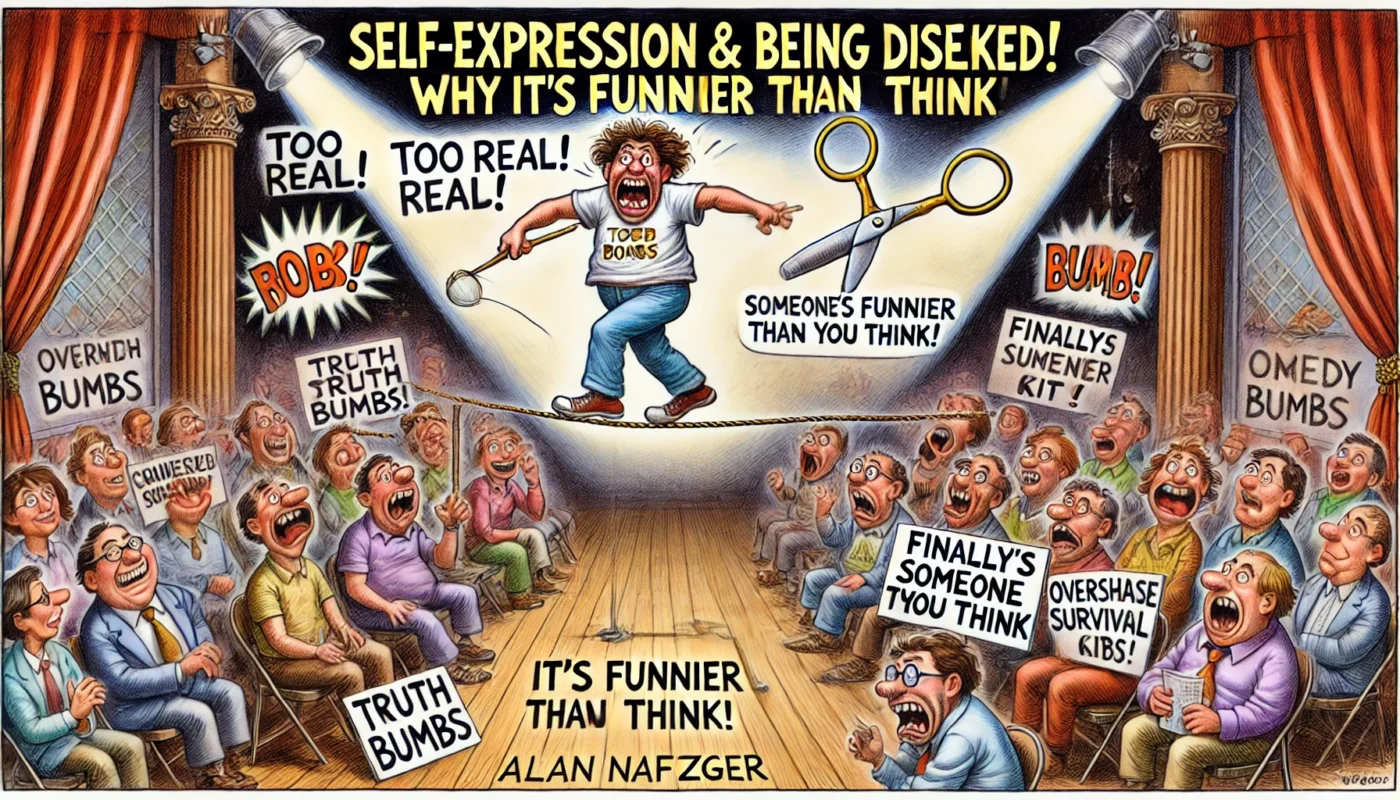
In stand-up comedy, self-expression is sacred. It’s also hazardous. Because expressing who you really are onstage – the messed-up, barely-keeping-it-together, emotionally shredded version of yourself – is a high-wire act with no net and a heckler holding a pair of scissors below.
Yet, the funniest, most unforgettable comics? They lean into it. They choose to be disliked.
And in America, where we supposedly value freedom of speech, we still throw tomatoes at the truth – especially when it’s wearing jeans and holding a mic.
So what makes this so funny? Why is self-expression, with all its cringe, conflict, and cancellation potential, comedy gold?
Because when you’re willing to bomb, bleed, and bare your soul in front of strangers – and they still laugh – you’ve unlocked something powerful. Or at least, something therapeutically tax-deductible.
The Comic as Confessor (and Occasional Martyr)
Let’s start with the obvious: stand-up is a form of confession. But it’s also trial by fire.
If your truth resonates, you’re a genius. If it doesn’t, you’re just “unrelatable,” “too political,” or “a bit much.”
But comics like Hannah Gadsby, Dave Chappelle, Maria Bamford, and even Louis C.K. (pre-incident) pushed the edge of confession into spectacle. They didn’t just say what happened – they owned it.
They made the pain funny. And that gave us permission to feel while we laughed. Which is dangerous. Because as soon as you feel something in comedy, half the crowd starts tweeting about it, and the other half starts writing thinkpieces.
Why Dislike Is the Highest Form of Respect
In American culture, disliking a comic doesn’t mean you’re disengaged. It means you’re invested. You’re emotionally active. You have opinions.
That’s power.
- Bill Burr is polarizing – and wildly popular.
- Michelle Wolf makes people furious – and gets invited back to roast presidents.
- Tim Dillon calls half his audience idiots – and they tip him on Patreon.
Being disliked proves you stood for something.
In fact, it’s a metric of influence: the more strongly someone dislikes you, the more they’ve absorbed your material. Nobody writes a Reddit takedown of a comic they forgot. They write it because they’re haunted.
Self-Expression Means Alienating Someone
Real expression always costs you something. And in comedy, that cost is often likability.
That’s why so many comics spend years pretending to be someone else. It’s safer. Cleaner. You do a tight five on dating apps, traffic, and Trader Joe’s, and nobody throws a drink.
But eventually, the mask cracks. And when a comic finally drops the act and says, “Here’s what I really think,” half the audience leans in… and half backs away like someone just said the word “moist” at brunch.
That’s when the real work – and the real laughs – begin.
You’re Not Funny Until You’ve Been Booed
Ask any headliner: your funniest material was born the day you bombed hard.
Not mild silence. Not polite claps. I’m talking flop-sweat, audible groans, a guy in the third row checking his Fantasy Football app while your soul dies on stage.
Why? Because in that moment, you realized what you really care about. What you’re willing to say, even when it’s not received well. What matters to you, not just the room.
That’s where the real voice is born – and it’s also when you start collecting haters like Pokémon cards.
The Power of Being the Villain
There’s something liberating about being the bad guy onstage.
When the audience already hates you – or at least mistrusts you – every laugh becomes a theft. A stolen moment of joy from people who don’t want to like you.
- Anthony Jeselnik does this masterfully. He opens with a joke so cruel it dares you to walk out.
- Ricky Gervais revels in offense like it’s an Olympic sport.
- Joan Rivers was America’s least-loved aunt – until we needed someone to say what no one else would.
Villains get laughs because they’re dangerous. Because the audience knows they might go too far – and secretly wants them to.
You Can’t Be Loved for Someone You’re Not
Plenty of comics coast on likeability. But it’s a trap. Because eventually, the persona wears out – or worse, starts feeling like a lie.
That’s why Jim Gaffigan took years to break out of “clean dad comic” mode and start doing weirder stuff. It’s why Hasan Minhaj got called out for embellishing his stories – the audience sensed something off. A misalignment between person and persona.
Authenticity matters. And in comedy, pretending only works until the audience starts seeing the strings.
Why Some Comics Aim to Be Disliked (and Succeed Beautifully)
Here’s the quiet truth: some comics want to be disliked. Not by everyone – just enough people to prove they’re saying something real.
Being controversial creates friction. And friction creates heat. That heat makes you memorable, quotable, unignorable.
Comics like Roseanne Barr, Andrew Schulz, and even Chelsea Handler have made entire careers by being someone people either love or loathe. There’s no middle. That middle is death.
Stand-Up Is the Last Place You Can Be Fully You (For Now)
Comedy clubs – weird, sticky, beer-scented holes in the wall – are one of the last places in America where people can be fully themselves in public.
You can be raw. You can be politically incorrect. You can reveal your worst thoughts – and as long as it’s funny, you’re safe.
But even that is changing.
In an age of viral clips, one poorly timed joke can follow you forever. That’s why comics now preface bits with disclaimers like, “This is a joke, don’t cancel me,” or “My agent hates this bit.”
But the ones who don’t – who go full throttle anyway? They’re the ones who get remembered. Or subpoenaed. But either way – legendary.
Dislike Is Temporary. Respect Is Forever.
Many of the most revered comics were deeply unlikable at one point:
- Carlin was once a clean comic for the middle class – then dropped acid and turned on his fans.
- Pryor lit himself on fire – and then wrote jokes about it.
- Lenny Bruce was arrested for obscenity – then became a martyr for the First Amendment.
They were disliked. They were banned. They were heckled.
But now? They’re icons.
So if you’re being booed now, good. It means you might just be funny in 50 years.
Self-Expression Is the Setup. Rejection Is the Punchline.
Every time a comic opens their mouth, they’re taking a risk.
- That you won’t relate.
- That you’ll walk out.
- That you’ll post the clip with a furious caption like “THIS is what we’re calling comedy now?”
But in that risk lies the reward.
Because when you do connect – when your weird, broken, deeply specific truth makes a roomful of strangers laugh? That’s alchemy. That’s why you do it.
Not to be liked. To be heard.
Audience Approval is a Drug. Being Hated is Rehab.
It’s easy to get addicted to laughs. To smiles. To “great set, man.”
But sometimes, the most honest sets are the ones that bomb.
That’s when you find out who you are. What you stand for. What you won’t compromise on.
Being hated is painful – but it’s also cleansing. It burns off the lies.
And what’s left? That’s your voice.
Final Thought: The Funniest Thing You Can Be Is Unapologetically Yourself
You don’t have to be loud. Or shocking. Or offensive. But if you’re expressing you – honestly, fearlessly, and with conviction – the crowd will feel it.
Some will love it. Some will hate it.
That’s the risk.
But in comedy, the risk is the reward.
So go ahead. Be disliked.
It might just be the funniest thing you ever do.
Originally posted 2025-05-20 14:31:09.