by
by The Dicey Business of Saying “No”: What Comics Can Learn from Nora Dunn’s SNL Boycott
Helpful Lessons from a Comic Who Took a Stand (and Got the Silent Treatment for 30 Years)
Thirty years ago, Nora Dunn made the kind of career decision that gets comedians either canceled or canonized — and in her case, it was a little of both. In 1990, when Saturday Night Live invited Andrew Dice Clay to host, Dunn said “no thanks,” called out his material for being aggressively misogynistic, and refused to appear on the episode. That decision sparked a media firestorm, earned her labels ranging from “brave” to “difficult,” and ultimately put her on the permanent naughty list of SNL showrunner Lorne Michaels — who forgives no one, except maybe Pete Davidson’s weed dealer.
But now, three decades later, in an age where open-mic nights double as Twitter trials, Dunn’s boycott feels like a masterclass in comic ethics, career risk, and what happens when your punchlines make a point.
So, what should today’s comedians take away from this still-smoldering moment in comedy history?
Let’s break it down.
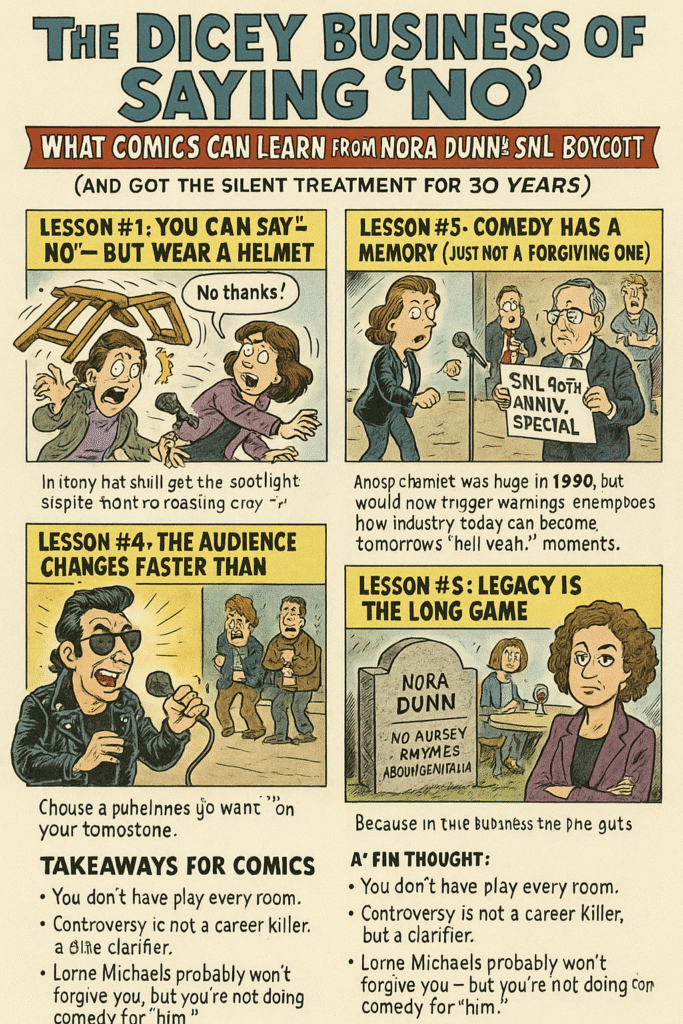
Lesson #1: You Can Say “No” — But Wear a Helmet
In comedy, everyone tells you to “find your voice.” They never mention that your voice might make half the audience throw furniture.
When Nora Dunn refused to stand next to Dice on live TV, she wasn’t just protesting a comedian — she was protesting an entire system that equated “equal opportunity offense” with “punching down at women, gays, and immigrants while in a leather jacket.”
And the comedy world lost it. The New York Post called her “humorless.” Joan Rivers labeled her “a traitor.” Dice himself said, “Who?” (Okay, that one might’ve been honest.)
But here’s the kicker: she said no anyway. And she lived. No tour bus fell on her. No heckler turned into a werewolf. She got hit with backlash, sure — but in the age of TikTok, a “backlash” is just engagement with better lighting.
Lesson #2: Not All Heat is Bad Heat
Dunn didn’t walk away with a sitcom deal or a Netflix special — she walked away with integrity and a bunch of New Yorker readers quietly nodding in a coffee shop.
But here’s the irony: she still got the spotlight.
To this day, you can’t Google Andrew Dice Clay without getting a sidebar about Nora Dunn’s boycott. Her act of protest became a legendary set piece — and she did it without roasting Clay directly. No insult jokes, no “yo mama” setups, just a clean exit and a mic drop so loud it echoed for decades.
So ask yourself: What kind of heat do you want? The kind that sells merch, or the kind that gets you remembered?
Lesson #3: Comedy Has a Memory (Just Not a Forgiving One)
According to Dunn, Lorne Michaels never forgave her. He even denied her a spot on SNL’s 40th anniversary special, while other alums got standing ovations for just showing up and not urinating on the set.
This is a critical reminder: Comedy institutions remember everything. But they also forget how much they owe to the people who stood up when it wasn’t cool.
Being a comic means navigating a tightrope made of barbed wire, over a pit of network notes and club owners with open tabs. If you take a stand, know that some doors will slam — and others will creak open just enough for you to squeeze through with your spine intact.
Lesson #4: The Audience Changes Faster Than the Industry
In 1990, the phrase “toxic masculinity” wasn’t mainstream — it was just called “Tuesday.” Dice’s act was huge, his persona outrageous, and his audience adored him like he was a chain-smoking Fonzie with Tourette’s.
Today? That same set would come with trigger warnings, an HR incident report, and an apology tour co-sponsored by Celsius and Ally Bank.
Yet Nora Dunn’s decision? It aged like a fine set at the Comedy Cellar.
The moral: the industry may not validate you in the moment, but audiences evolve. Your choices today could end up being tomorrow’s “hell yeah!” moments — even if they start off as awkward silences.
Lesson #5: Legacy Is the Long Game
Dice Clay faded. Dunn moved into character work and indie films. Neither one became the next Carlin. But only one of them became a symbol of artistic resistance. (Hint: it’s not the one with a nursery rhyme about genitalia.)
If you’re a comic, you have to decide: are you here to kill tonight or be remembered tomorrow?
You don’t need to be a martyr to make meaningful choices. But Dunn proved that sticking to your comedic compass matters. Even if no one claps for you at the afterparty.
Takeaways for Comics
-
You don’t have to play every room. You’re allowed to skip a gig that doesn’t align with your values. Even if it’s SNL. Even if it’s Vegas. Even if it’s a cruise ship full of MLM moms.
-
Controversy is not a career killer. Sometimes, it’s a career clarifier. Be strategic, be bold, and know the difference between publicity and self-respect.
-
Lorne Michaels probably won’t forgive you. But you’re not doing comedy for him, are you?
-
Choose the punchlines you want on your tombstone. Comedy is full of cheap laughs — the best comics are the ones who know when to walk away from them.
Final Thought:
If you want to be a comic who lasts, don’t just learn timing and crowd work. Learn to take a stand — and stand by it when the applause dies down.
Because in this business, the guts to say “no” might be the funniest thing you ever do.
Disclaimer: This article is written by humans with working memories and questionable Wi-Fi. Any resemblance to current open mic lineups is purely accidental. For career advice, please consult a ghostwriter with PTSD from 1990s green rooms.
ComedyWriter.com — where your future material learns from your past mistakes.
Originally posted 2025-05-13 10:33:44.