 by
by How to Siphon Laughter Like Gasoline: The Art of Exchanging Energy in American Comedy
Stand-Up Isn’t a Performance — It’s a Circuit Board with Sweat Glands
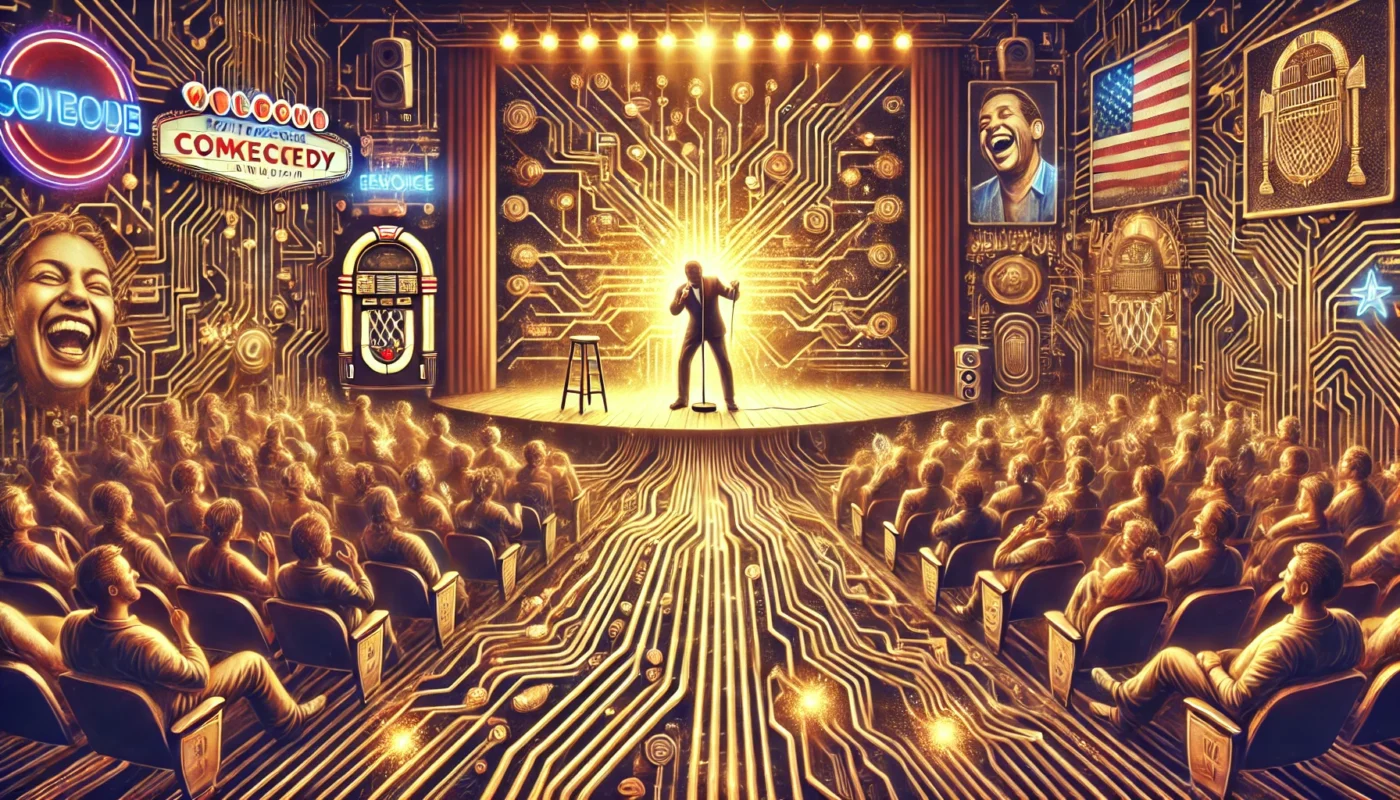
In the world of American comedy, a show isn’t a lecture, it’s a chemical spill — dangerous, contagious, and lighting up the crowd like a human Tesla coil. Every time a stand-up comic takes the mic, they’re not delivering a monologue; they’re conducting a high-voltage feedback loop where laughter is both the product and the power source. Rhys Darby may have called it “electricity” in the UK, but in America, it’s less about clean energy and more about hijacking the national power grid with a Hot Pocket and a punchline.
Jerry Seinfeld famously said, “Stand-up is like boxing — except your opponent is a thousand drunk strangers and your gloves are made of feelings.” Comics don’t just deliver jokes; they extract laughter, siphoning energy from the crowd like a mechanic with a gas hose. You bomb, and it’s a blackout. You kill, and the audience glows like a Times Square billboard.
The Red-Bull Feedback Loop
In American clubs, the exchange of energy starts before the comic says a word. Think of the audience as a caffeinated organism, one that’s just sat through two overpriced margaritas, a DJ from the early 2000s, and an emcee who mispronounced your name as “Comedian Jebediah.”
It’s a combustible atmosphere. You walk out and say, “Hey y’all,” and instantly, the feedback begins. In L.A., they lean back, waiting to see if you’re TikTok famous. In Austin, they lean forward, daring you to be politically incorrect. In New York, they’re already laughing — at the idea of showing vulnerability in public.
Energy is sensed, borrowed, returned. If you kill, the audience gives you a wave to surf. If you bomb, they become a fog bank to crash into.
Carlin Conducted Voltage. Pryor Conducted Fire
George Carlin understood this current better than anyone. He didn’t just do bits. He built electric fences out of language. The audience leaned forward because Carlin’s rhythm — fast, philosophical, profane — worked like a defibrillator. His cadence zapped people into attention, delivered on laughs, and charged them to rethink reality.
Richard Pryor didn’t even need to speak to get a pulse from the room. The mere act of walking onstage — battered, sweaty, eyes wide — was like a lightning rod getting plugged into a thunderstorm. His silences were more powerful than most punchlines, because he trusted the current. He knew if you waited just long enough, laughter would rush in like water breaking a dam.
Comics as Conduits, Not Celebrities
In American comedy, comics are expected to be mediums, not stars. This isn’t acting. This isn’t TikTok. If you come onstage thinking the show is about you, the crowd will short-circuit you like a motel hair dryer in a bathtub.
Louis C.K. (before the “incident”) had this knack for melting the border between comic and crowd. He didn’t tell jokes to people — he told them with people. His jokes about parenting, shame, or the mental deterioration of divorced men over 40 weren’t just observational — they were participatory confessions. The audience howled because they saw their own trash thoughts being recycled into gold.
The Heckler as Broken Fuse
Of course, not all energy is positive. Sometimes, the audience gives you a surge, other times a short. Hecklers aren’t just disruptive — they’re malfunctioning amplifiers. You say, “So I was dating this girl,” and some guy yells, “You’re gay!” as if he’s trying to debug the circuit with a sledgehammer.
Comics like Bill Burr thrive on this. Burr doesn’t diffuse bad energy — he pours kerosene on it and hands the crowd a match. You heckle Burr, and you’ll end up part of the set, your social security number included in the punchline. He doesn’t restore order — he restores voltage.
Open Mics: The Graveyard of Dead Energy
Nowhere is the fragility of comedic energy more obvious than at the American open mic. Picture a Holiday Inn conference room at 11 p.m., seven comics in cargo shorts, and one guy doing three minutes on how much he hates women and doesn’t understand consent. You feel the vacuum. The audience isn’t hostile — they’re apathetic electrons. You start sweating, the mic feeds back, and even your soul cringes.
And yet, these rooms are where energy sensitivity is trained. The open mic is the comedy dojo where you learn that one person laughing louder than silence is still a win.
Women Comics Run on a Different Grid
Let’s be honest: the energy exchange changes if you’re not a straight white male. For women comedians, the audience’s voltage is filtered through gendered expectations. A man storms onstage yelling about sex and gets applause. A woman says “vagina” and half the room short-circuits like their pacemakers heard a swear word.
Ali Wong flips the current. Her delivery is like electroshock therapy with a Gucci purse. She smiles, sips water, and talks about fetal development while frying the entire audience with one-liners about sex, culture, and Asian-American politics. She doesn’t ask for energy — she commandeers it.
The College Crowd Is Like a Power Plant on Fire
Performing for American college students? That’s like trying to plug into a grid that’s already protesting its own electricity. Gen Z wants emotional safety, political accuracy, and trans-inclusive syntax — but also wants to laugh at things their therapist wouldn’t approve.
Comics like Hasan Minhaj thread this needle expertly, turning cultural identity into a form of controlled voltage. He brings his whole family tree into the room and invites the audience to plug in, but only after a content warning and a PowerPoint slide.
Churches, Casinos, and Chuckle Famine Zones
American comics know that energy varies by venue. A Texas megachurch might have great acoustics and zero sense of irony. A casino crowd in Reno might laugh, but only after you say the punchline twice and they check their chips.
Comics like Jim Gaffigan thrive in weird rooms. His tone — dry, self-deprecating, Midwestern — can heat up even the coldest crowd, because he’s mastered the art of comedy thermodynamics: add enough butter jokes, and even a skeptical audience will melt.
How to Know the Circuit is Live
You know you’ve tapped into the audience’s grid when:
-
Laughter overlaps and feeds itself like a looped sample.
-
Someone in the crowd says “Jesus Christ” between breaths.
-
The guy who looked angry before now has his hand over his heart, convulsing with joy.
You also know you’ve lost the current when:
-
Someone checks their phone.
-
You can hear the AC hum louder than the punchline.
-
A baby in the back starts crying — and it’s funnier than your closer.
Comedian Quotes on the Energy Exchange
“It’s like surfing — you can’t control the wave, but you better damn well learn to ride it.” — Dave Chappelle
“Sometimes they laugh, sometimes they stare. Either way, I got paid.” — Wanda Sykes
“Comedy is just energy, words, and sweat arranged in the right order.” — Kevin Hart
“The audience doesn’t want to like you. They want you to make them like you.” — Joan Rivers
The Final Law of Energy: Never Fake It
You can’t fake the circuit. American audiences have built-in BS detectors, probably from watching too many reality shows. If you’re trying too hard, they feel it. If you’re too polished, they mistrust it. You need to let them see the wire, the fray, the human voltage underneath the act.
In a post-TikTok, post-cancel culture America, authenticity has become the new electricity. We don’t just want the laugh — we want to feel the spark that created it. That’s why the best comics in America aren’t just writers or performers…
They’re walking power plants with a mic and a mission to light up the room before it goes dark.
Originally posted 2025-05-16 07:50:39.