 by
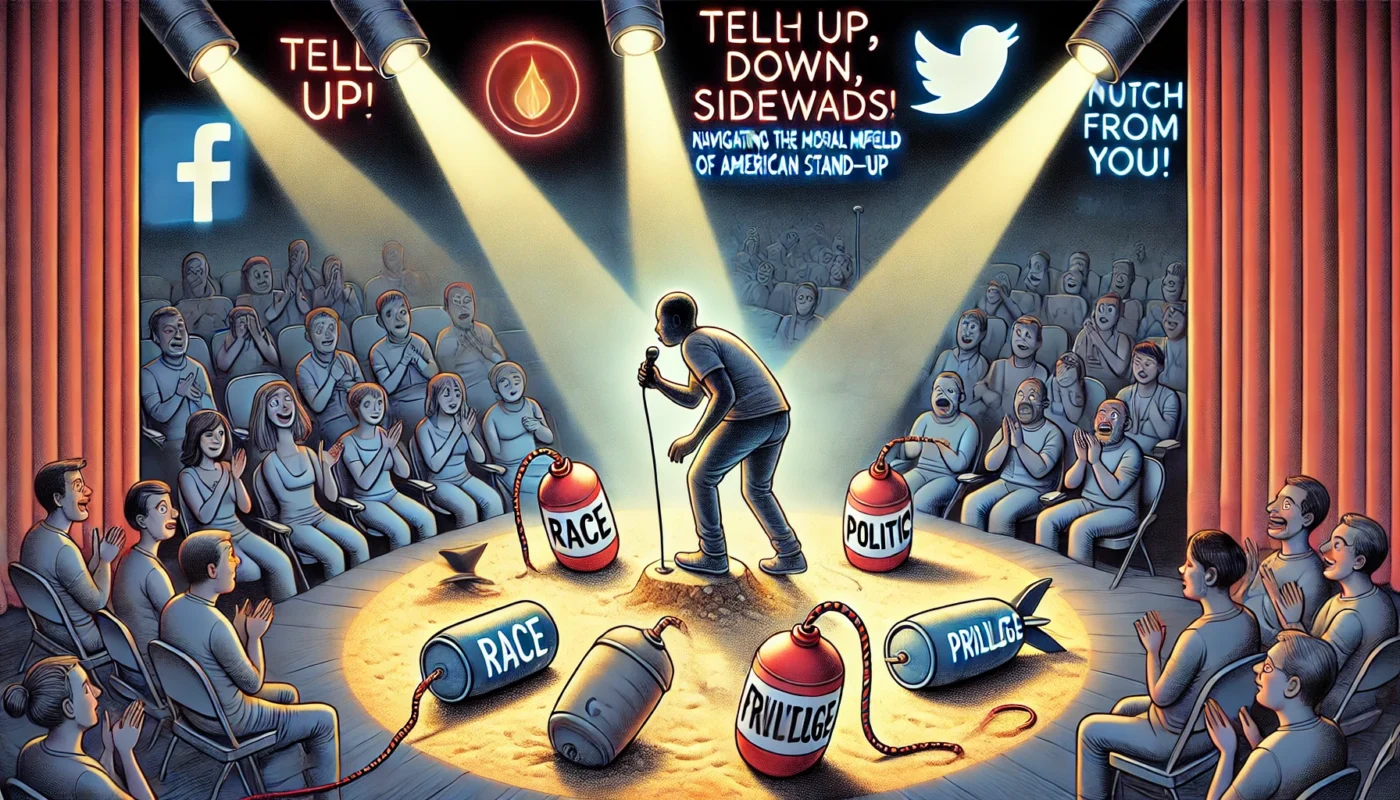
by Punch Up, Down, Sideways: Navigating the Moral Minefield of American Stand-Up
The Crowd Wants Truth — But Not From You
Modern American comedy audiences are like TSA agents: they say they want honesty, but if you show up with too much truth, you’re getting pulled into secondary screening. Everyone says, “We love comedians who push boundaries!” — until one does, and suddenly we’re in a TikTok tribunal about a joke involving fish, consent, and a misunderstood Chili’s commercial.
The great paradox of stand-up today? The audience wants to be challenged… but not by someone they don’t already agree with.
Comics now face a moral maze where the wrong punchline can end your career, but the right one can make your HBO special trend harder than a Kardashian divorce.
Chris Rock Didn’t Hit First — He Hit Hardest
Long before the Oscars slap became a meme with feet, Chris Rock was perfecting the art of punching all directions. He didn’t play sides — he played every side, then set the stage on fire.
His material? Bold, biting, funny, and uncomfortable:
-
“You can drive a car with your feet if you want to — that don’t make it a good idea.”
-
“Nobody hates black people more than other black people.”
It wasn’t divisive. It was surgical. And he didn’t care who flinched. If you were stupid, hypocritical, or rich — especially if you were all three — you were fair game.
Rock’s approach wasn’t just about offense. It was about balance. He understood that challenge doesn’t mean cruelty — it means calling BS with precision.
Who Can Say What: America’s New Joke Licensing System
Let’s face it. In 2025, stand-up is governed by an unspoken bureaucracy:
-
You’re gay? You can joke about homophobia.
-
You’re Black? You can joke about racism.
-
You’re a straight white guy with a podcast? We need to see your papers.
The unspoken rules of joke-licensing have become so complex that comedians need ethics consultants just to workshop new material. “Can I joke about cats with anxiety if I’m not a veterinarian?” “Is it okay to satirize billionaires if I have an AmEx Gold?”
The Sarah Silverman Paradox: Offend First, Explain Later
Sarah Silverman made a career out of weaponized innocence. She’d say the most outrageous thing possible, blink, and smile like she just offered you a cookie. Audiences either laughed or panicked — or both.
Silverman challenged the idea that intent doesn’t matter. Her defense: “If I’m clearly mocking the bigot, not the target, how am I the problem?”
And yet, even she got caught in the culture shift — admitting later that “some of those old jokes don’t age well.”
Welcome to 2025, where even apologizing has a punchline.
The ‘Punching Down’ Debate Has No GPS
You hear it constantly: “Don’t punch down.” But what does that mean?
If a comic jokes about white girls and Starbucks, is that punching down? What if the girl owns the Starbucks? What if she also works there? What if she’s armed with an astrology podcast and 3 million followers?
The lines of power are no longer vertical. They’re a Rubik’s Cube. Economic, racial, sexual, social — comics are expected to calculate this geometry in real time, onstage, while drunk people yell “Do the bit about ketamine!”
Dave Attell said it best: “I don’t know if it’s punching up or down — I’m just swinging wildly and hoping I hit a premise.”
Audience Morality is Mood-Based
On Friday night, the crowd loves your abortion joke. On Sunday brunch, the same crowd files a Yelp review: “Too many uterus references with my eggs Benedict.”
Comedians have to read the emotional weather of the room — are we in a pro-cancel, anti-cancel, irony-only, deadpan-allowed environment? Or is this a crowd that still thinks Dane Cook was edgy?
The joke doesn’t change. But the perceived morality of it does — depending on venue, day, who clapped before you went up, and whether or not a dog is in the front row wearing a hat.
When You Punch the Mirror
Some of the most daring comedy is self-directed cruelty. Comics like Marc Maron and Sam Morril have made art out of turning their inner despair into a roast battle against themselves.
It’s a form of moral judo. You attack yourself so ferociously that the audience lets you attack others. “If he’s that mean to himself,” they think, “he can’t be that dangerous.”
But it’s also emotionally exhausting. Comics become human piñatas, whacked nightly for the entertainment of people who don’t know if it’s okay to laugh at alcoholism.
Punching Up Isn’t Always Uplifting
Sometimes, the moral target of a joke isn’t a villain — it’s a social truth we all enable. That’s where comics like Wanda Sykes shine. She’ll joke about race, class, or healthcare in a way that makes you laugh first — and then realize you’re part of the problem.
Her genius is in framing the system as the villain. It’s not you — it’s all of us. That collective responsibility is challenging because it removes scapegoats.
And without scapegoats, audiences feel… naked.
And they don’t always like that.
Political Comedy Isn’t About Policy — It’s About Permission
When Hasan Minhaj or Roy Wood Jr. jokes about politics, they aren’t doing news satire — they’re negotiating with the audience. They’re testing what people are ready to hear.
Political comedy doesn’t work because it’s accurate. It works because it validates your fear, then laughs at it.
The challenge? Say too much truth, and you’re lecturing. Say too little, and you’re milquetoast. Say it the wrong way, and you’re a trending topic for the wrong reasons.
Joe Rogan’s Anti-Delicate Delicacy
No exploration of challenging comedy would be complete without The Rogan Factor.
Joe Rogan is not so much a stand-up comic as he is a bro-scientist with a fog machine. His fans love him for “telling it like it is.” His critics accuse him of telling it like it never was, but with confidence.
Rogan challenges audiences by refusing to challenge himself — and that’s its own kind of confrontation. He treats complexity like creatine: not necessary, but it helps you look powerful.
To his credit, he doesn’t back down. To his detriment, sometimes he backs into idiocy.
And somehow, both extremes make him richer.
What the Funny People Are Saying
“Punching down is easy. Punching up takes aim. Punching sideways gets you drinks thrown at you in Cleveland.” — Roy Wood Jr.
“A good comic reads the crowd. A great comic rewrites them.” — Nikki Glaser
“Comedy is not therapy. It’s trauma with a tip jar.” — Sam Morril
“If everyone agrees with you, you’re a preacher. If half disagree, you’re a comic. If everyone’s mad? You’re doing something right.” — Dave Chappelle
“People don’t laugh at what’s funny. They laugh at what makes them feel seen and slightly ashamed.” — Michelle Buteau
So Who’s Safe to Joke About?
Let’s review your current joke-safe targets (subject to change based on Twitter):
-
Billionaires
-
Reality TV stars
-
Your ex (but only if they’re fictionalized)
-
Dogs with Instagram accounts
-
The entire state of Florida
Unsafe targets:
-
Moms
-
Librarians
-
Anyone in Gen Z
-
Any trauma you didn’t personally survive
-
The concept of brunch (still under review)
The Risk is the Reward
Challenging the audience isn’t about being offensive — it’s about being fearless. It’s walking into a room, saying the unsayable, and then rebuilding the moment without losing the humanity.
The best comics don’t just punch — they offer a hand after the hit. They know the goal isn’t destruction. It’s revelation.
And if the audience leaves slightly more disturbed than they arrived?
Perfect.
Because that’s not just comedy.
That’s American truth with a two-drink minimum.
Originally posted 2025-05-16 08:35:01.