 by
by How-to Guides: The Clumsy Birth of DIY Stand-Up Manuals
When Learning to Be Funny Meant Reading a Really Weird Book
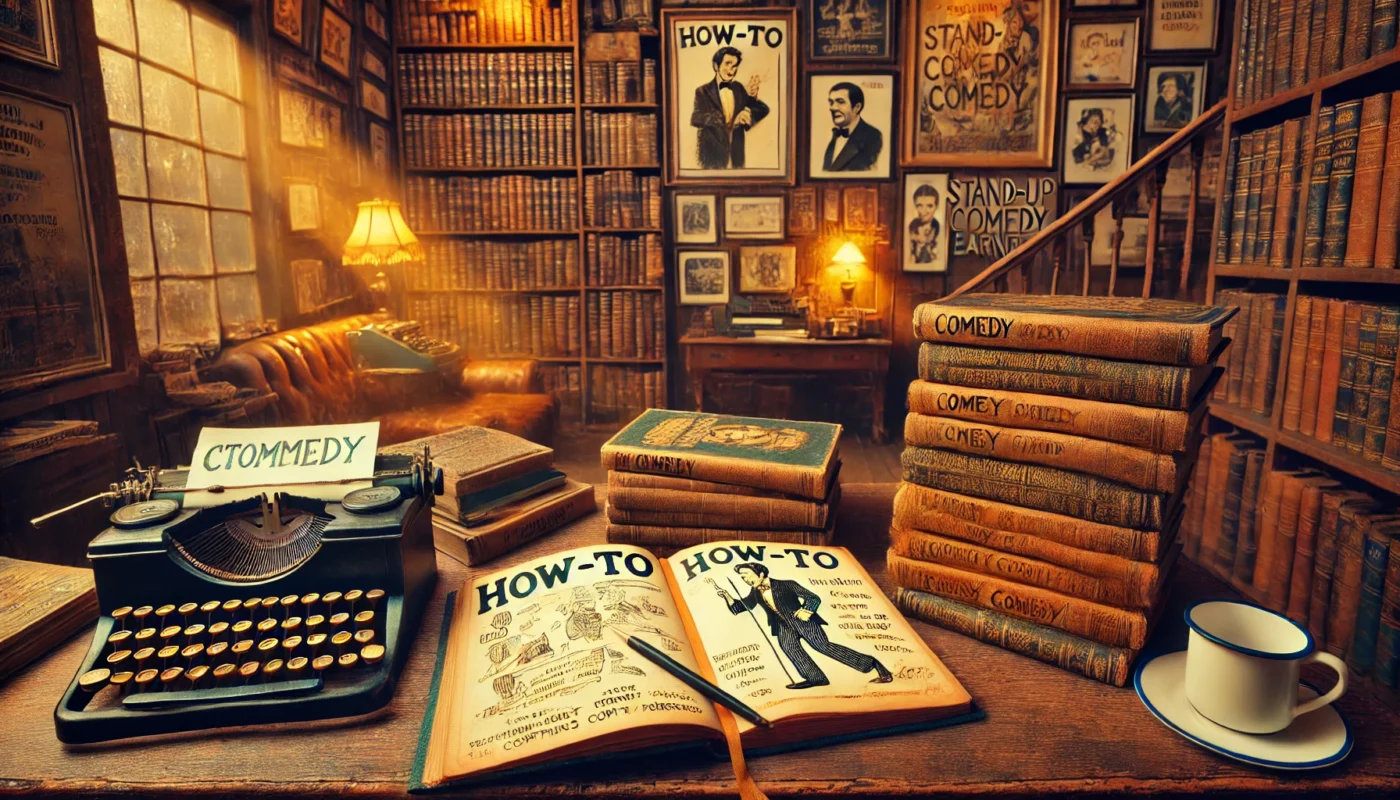
Imagine you’re an aspiring stand-up comedian in 1945. There’s no YouTube, no TikTok, no podcasts about “finding your voice.” There’s just you, your deeply questionable jokes about mother-in-laws, and — if you’re lucky — a dusty book called How to Become a Comedian.
Written by an aging vaudeville star.
In a font smaller than your hopes.
With advice that, even then, was probably outdated.
Welcome to the chaotic birth of DIY stand-up comedy manuals — the strange, wonderful, mostly useless literary genre that tried to teach America how to be funny.
The First How-To Manuals: Vaudeville Wisdom on Paper
The earliest comedy how-to guides weren’t really about stand-up as we know it today.
They were about performance:
-
How to stand.
-
How to move.
-
How not to pass out from stage fright.
Books like Lupino Lane’s How to Become a Comedian (1945) were based on vaudeville traditions, where timing a pratfall or mugging for the cheap seats was just as important as the words coming out of your mouth.
These books offered advice like:
-
“Always keep your face expressive.”
-
“Pause after the punchline.”
-
“Enunciate clearly so the folks in the balcony can understand you.”
Solid advice…if you were performing at the Orpheum Theater in front of 2,000 people who had never seen television before.
For modern stand-ups hoping to survive a drunk Thursday night crowd at Chuckle Factory, it was like trying to learn Fortnite strategies from a Civil War manual.
The One-Size-Fits-All Problem
These early manuals treated comedy like plumbing: follow the blueprint, tighten the nuts, and boom, laughs!
Which led to horrifyingly rigid advice, such as:
-
“All jokes must follow the formula: setup — punchline — topper.”
-
“Never talk about politics or religion.”
-
“Avoid regional accents; they confuse the audience.”
In other words:
Be funny, but don’t be too real.
Be “safe.”
Be “universal.”
Be…bland.
If Richard Pryor, George Carlin, or Joan Rivers had followed this advice, comedy would still sound like bad Catskills lounge acts yelling about their mother-in-laws and meatloaf.
Thankfully, the best comics read these manuals — and immediately broke every rule.
The 1980s Revolution: Judy Carter and Personal Comedy
Then came the 1980s, and with it, a breath of fresh (and deeply personal) air.
Judy Carter’s Stand-Up Comedy: The Book smashed the idea that comedy had to be “universal.” She taught that your life — messy, weird, tragic, hilarious — was the goldmine.
Instead of:
“Tell a joke about airline peanuts!”
It was:
“Talk about how you cried in a parking lot because your date ghosted you…then add a punchline.”
Carter introduced radical concepts for the time:
-
Setups don’t have to be short.
-
Punchlines can be honest.
-
Pain is funny if you frame it right.
This shift opened the floodgates.
Suddenly, stand-up wasn’t about old jokes — it was about you.
Your trauma.
Your weird dating life.
Your irrational hatred of cilantro.
And audiences ate it up.
Why How-To Guides Are Often Hilariously Outdated
Even today, new “how to be funny” books come out every year.
And most of them age about as well as a jug of milk left in the sun.
Typical outdated advice includes:
-
“Never curse!” (Good luck telling that to half of Netflix’s comedy specials.)
-
“Women shouldn’t talk about their bodies.” (Tell that to Ali Wong’s ticket sales.)
-
“Stay away from political material!” (Meanwhile, John Oliver wins Emmys weekly.)
Why do they keep getting it wrong?
Because comedy evolves faster than almost any other art form.
What was shocking in 1950 is boring now.
What was edgy in 1995 is cringey today.
A good rule of thumb:
If a book tells you there’s only one way to be funny, throw it out.
Or better yet, read it at an open mic.
You’ll get more laughs than you bargained for.
DIY Stand-Up: The Good, the Bad, and the Utterly Weird
The Good:
Some manuals actually teach useful things:
-
How to structure a joke.
-
How to pace a set.
-
How to survive a bombing without joining a monastery.
Books like Judy Carter’s work, Greg Dean’s Step by Step to Stand-Up Comedy, and Steve North’s How to Kill at Stand-Up offer real, battle-tested advice about pacing, setup, and audience psychology.
The Bad:
Some manuals teach absolute nonsense:
-
“Use five jokes per minute!” (Robots might love it. Humans won’t.)
-
“Never be controversial!” (Sure, if you want to be forgettable.)
-
“Always end with a callback!” (Even if it’s about your cat dying? Come on.)
The Weird:
Some books are so oddly specific they feel like parodies:
-
“Always carry three props: one visual, one edible, one throwable.”
-
“Smile exactly 2.5 times per minute.”
-
“Start every set by pretending to mispronounce the venue’s name for cheap laughs.”
You wonder if some of these books were secretly written as jokes themselves.
Personal Stories: How Bad Advice Made Great Comics
Almost every major stand-up has a story about terrible advice they gleefully ignored.
-
Chris Rock was told to “stop being so angry.” His rage became his signature.
-
Ellen DeGeneres was warned, “Don’t talk about your personal life.” Guess what she built her brand on?
-
Dave Chappelle was advised, “Be more mainstream.” He moved to a farm instead and became a legend.
The lesson?
Sometimes bad advice is the best fuel.
It teaches you what not to listen to.
Reading a terrible stand-up manual can actually help you sharpen your instincts — just by making you violently disagree with every page.
Why DIY Isn’t Enough (And That’s OK)
Reading books is great. Watching stand-up is better.
But nothing — nothing — replaces real-world stage time.
You can read a hundred manuals about comedy.
You can study every Netflix special ever made.
You can know the entire history of the Catskills and memorize every “tight five” structure.
But until you stand under hot lights, holding a too-heavy mic, forgetting your next punchline, sweating through your shirt while six people in the front row stare at you like you’re a defective vending machine?
You don’t know anything yet.
DIY can teach you the map.
But you still have to make the journey.
You have to bomb.
You have to die onstage, die inside, and live again.
And no book can suffer for you.
How to Actually Use a Comedy Manual (Without Becoming a Robot)
If you do pick up a comedy guide, here’s how to use it wisely:
-
Learn the basics: Structure, timing, audience awareness — these don’t change.
-
Ignore the rigid rules: If the book says, “Never talk about politics,” immediately write a political joke.
-
Steal the tools, not the voice: Learn setups and punchlines. Then apply them to your voice, not the author’s.
-
Stay flexible: Know that comedy evolves constantly. What worked five years ago might not work now.
-
Bomb anyway: Use the book to prepare. But accept that bombing is still required. Always.
Final Thoughts: Why We Still Love (and Need) How-To Guides
Look, comedy manuals are ridiculous.
They’re clumsy.
They’re outdated before they hit the shelf.
They’re full of weird diagrams about “the laugh curve” that make no sense.
And yet…they matter.
They’re part of comedy’s long, messy, beautiful tradition of trying — desperately — to turn chaos into something teachable.
They’re proof that comedy isn’t magic.
It’s craft.
It’s work.
It’s failure, rewritten 10,000 times into success.
So buy the dumb book.
Highlight the good bits.
Laugh at the bad advice.
Learn what you can.
Ignore what you must.
And then go find a microphone.
Because the real manual?
The real course?
It’s written every time you get onstage, risk your dignity, and chase that impossible, beautiful roar of laughter.
And that’s something no book — no matter how outdated or weird — can ever take away from you.

Originally posted 2025-04-29 01:44:51.