 by
by The Body Says What the Joke Can’t: How Comics Use Movement to Say the Unspeakable
When the Words Run Out, Fall Over a Couch and Trust the Applause
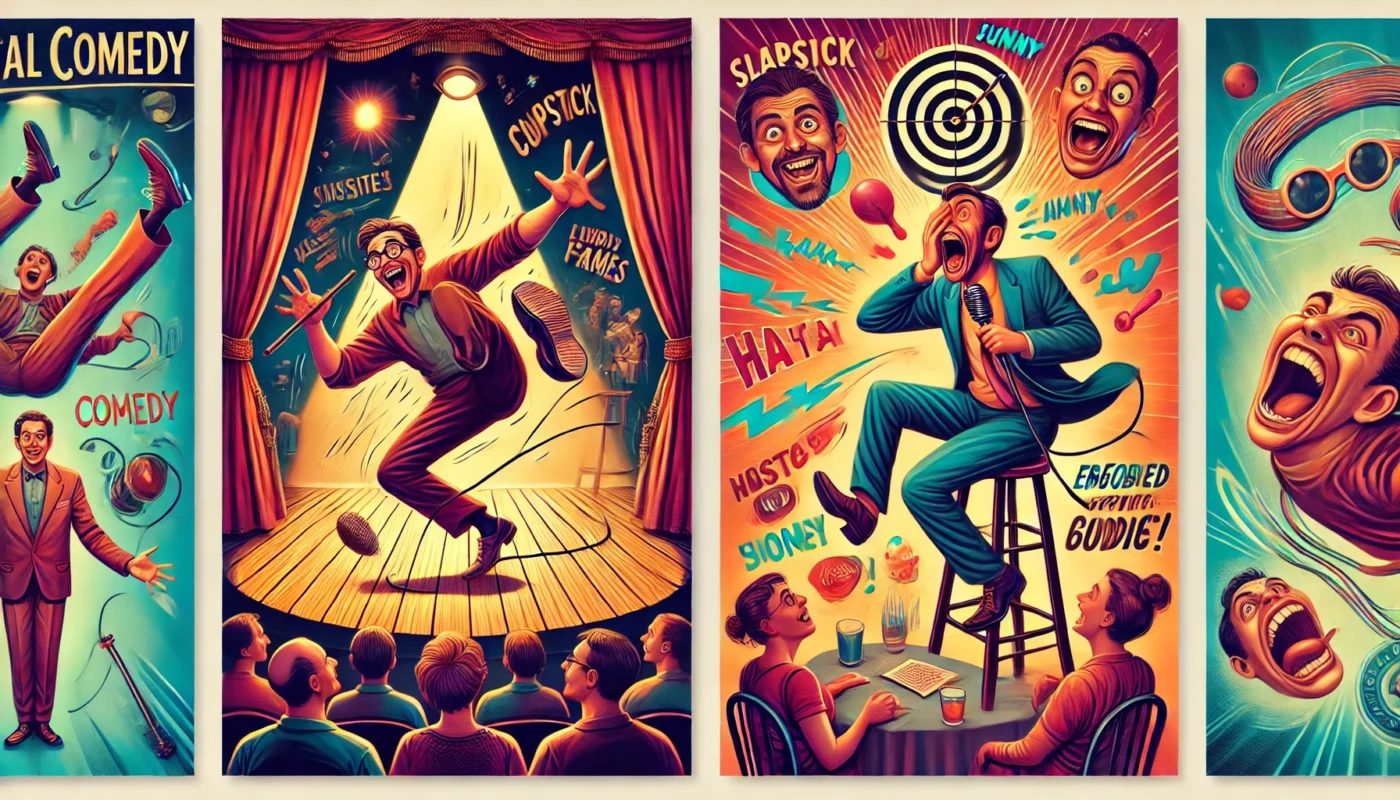
Verbal comedy is elegant. Intellectual. A craft.
Physical comedy? It’s a dangerous sport where the prize is a laugh and the injury is almost always real.
You don’t need punchlines when you’ve got:
-
A face that folds like origami,
-
A body that flails like a used car inflatable,
-
And timing sharp enough to turn a trip into a Broadway finale.
Because sometimes, the funniest thing a comic can say… is nothing.
They just need to fall off a stool like they meant it.
Chris Farley: Mayhem in a Windbreaker
Farley didn’t tell jokes.
He launched them, wearing khakis that defied gravity and a torso that screamed in capital letters.
Every SNL sketch he did had three ingredients:
-
A shirt that barely survived.
-
A table that definitely didn’t.
-
A performance that left audiences and drywall equally cracked.
“I live in a van… down by the river!”
That wasn’t a line. That was a full-body explosion of American rage and cholesterol.
Farley’s brilliance wasn’t in subtlety. It was in sacrificing his entire cardiovascular system for a single laugh.
Kate McKinnon: The Body as a Swiss Army Knife of Ridiculousness
Kate doesn’t play characters. She morphs into them like she’s auditioning for The X-Men: Comedy Edition.
-
Her posture.
-
Her jawline.
-
Her ability to control each muscle like they’re unionized performers with SAG cards.
She plays aliens, weird aunts, Hillary Clinton, and suburban dads with back pain using nothing but commitment and weird pelvic tension.
Her physicality isn’t about chaos. It’s about precision weirdness.
She’s not flailing. She’s conducting a symphony of deliberate awkwardness.
And the audience? They can’t look away.
Silence, Stillness, and the Power of Not Moving
Physical comedy isn’t always about movement.
Sometimes, it’s about the absence of it.
-
Holding a stare one second too long.
-
Freezing mid-bite with suspicious eyes.
-
Standing completely still while chaos unfolds around you.
Think:
-
Buster Keaton’s stone face during a hurricane.
-
Kristen Wiig’s Target Lady pausing before mispronouncing “papaya.”
Stillness is tension. It’s a setup. It says to the audience:
“This is about to go off the rails — and you won’t see it coming.”
And when the tension breaks?
The laugh is seismic.
The Mic Stand as Comedy Partner (or Victim)
Some comics treat the mic stand like furniture.
Others? They turn it into:
-
A dance partner,
-
A jousting weapon,
-
A prop in a one-person war against their own material.
When a comic physically interacts with the mic stand — caressing it, slamming it, adjusting it like it’s a weird Tinder date — the room ignites.
Because that’s not just movement.
That’s character, metaphor, insecurity, and energy management in one metal pole.
Bo Burnham: The Stand-Up Choreographer of Anxiety
Bo doesn’t just tell jokes. He choreographs neurosis.
His specials — especially Inside — feature:
-
Jerky movements.
-
Intentional dance breakdowns.
-
Body postures that scream, “This is funny because I’m clearly unraveling.”
He uses his body like punctuation.
He’ll pause, twist, twitch, moonwalk emotionally, then collapse into a joke that hits harder because you saw the descent coming.
Bo is a physical comic for the digital age — ironic, twitchy, and painfully aware that you’re watching.
The Face Is a Comedy Weapon
Don’t underestimate:
-
The slow blink.
-
The confused squint.
-
The smirk that precedes a devastating aside.
A well-timed eyebrow raise has stopped wars, ended relationships, and opened Netflix deals.
Think:
-
Maya Rudolph’s thousand-yard stares.
-
Martin Short’s rubbery mug collapsing in on itself.
-
Kristen Schaal’s bug-eyed innocence used to weaponize chaos.
The face doesn’t need a joke. It is the joke.
And when a comic knows their face is a prop? That’s face-slapstick mastery.
The Walk Is the Bit
You ever notice how comics walk on stage?
Some glide. Some strut. Some limp like they just fought off raccoons for a parking spot.
That walk is part of the act.
The way a comic moves — to the mic, around the mic, away from the mic — tells the crowd everything:
-
Confident?
-
Anxious?
-
Deranged?
-
About to confess something illegal but hilarious?
Every gesture becomes character.
You’re not watching a person tell jokes.
You’re watching a human vessel trying to survive the spotlight through motion.
Audience Laughter Has Rhythm — And Physical Comedy Plays the Beat
Words can be paused. But movement creates a groove.
When a comic dances, flinches, repeats motions, or commits to a repeated bit (falling three times instead of once)… the audience starts to anticipate the rhythm.
It becomes:
-
Setup (wobble)
-
Tension (recovery)
-
Release (collapse)
That’s a physical punchline. It feels different. It hits like music.
And when it’s perfectly timed? It kills.
What the Funny People Are Saying
“My body is a temple. A temple full of banana peels and broken chairs.” — Chris Farley (probably)
“The best punchlines are the ones you land with your knees.” — Kate McKinnon
“Sometimes I walk across the stage just to make the audience wonder what I’m about to fall off.” — John Mulaney
“Stillness is a weapon. If you hold it long enough, the room breathes with you.” — Kristen Wiig
“My body is in the joke before my mouth even opens.” — Bo Burnham
Laughter Is a Full-Body Reaction — So Why Not Use Yours?
The best stand-up isn’t just writing. It’s movement matched with meaning.
A shrug can be a thesis.
A pratfall can be a character arc.
A twitch can be a scream.
In a world where everyone’s glued to screens and drowning in words, physical comedy reminds us we’re still mammals in space reacting to other mammals flailing around.
So next time you see a comic:
-
Raise an eyebrow,
-
Fall backward into a drum set,
-
Or just stare into the void for 17 seconds…
Laugh hard.
Because you’re not just watching comedy.
You’re feeling it in your bones.
Originally posted 2025-05-16 09:54:22.