 by
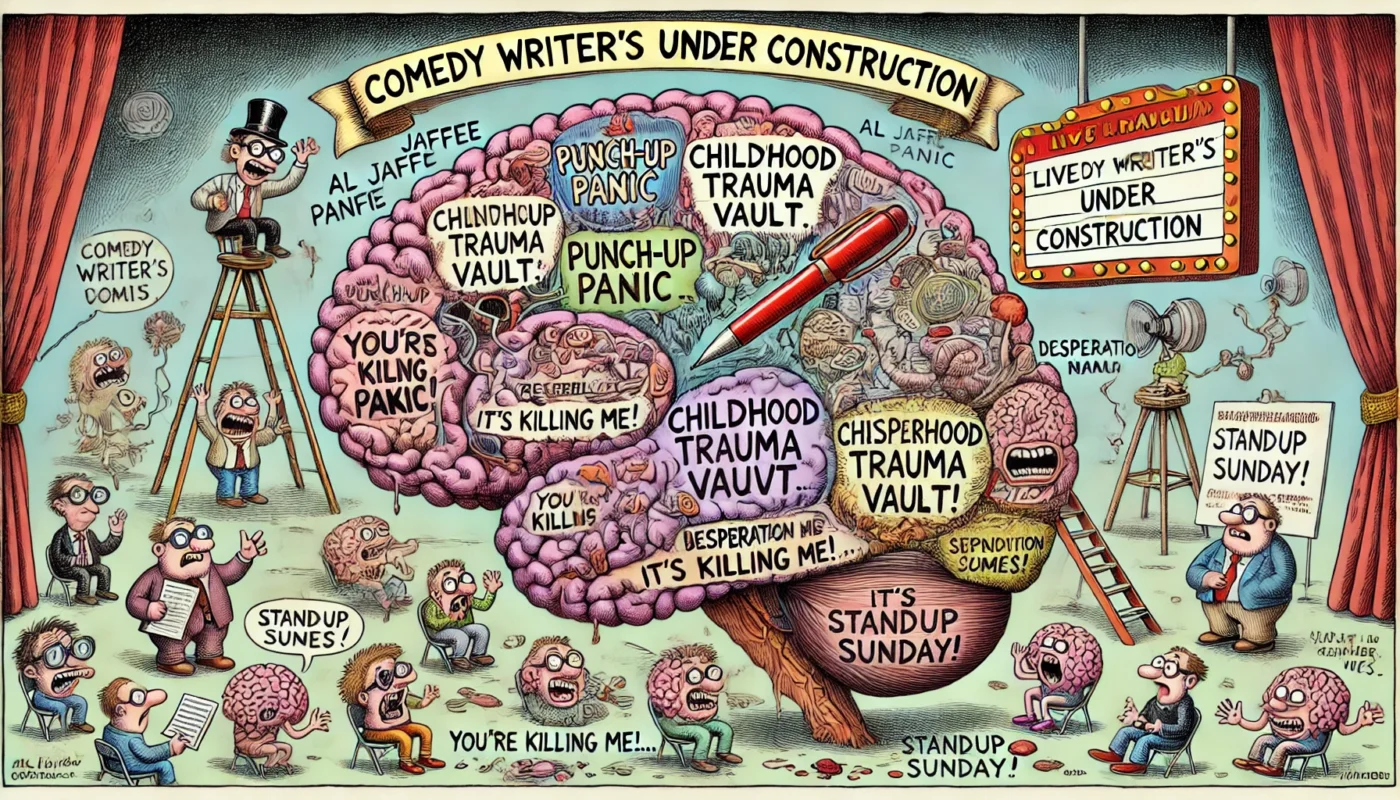
by Comedy Writer’s Brain Under Construction: A Satirical MRI of Standup Comedy’s Most Dangerous Organ
Introduction: The Most Dangerous Weapon in Standup Comedy
Scientists at the International Humor Neurology Institute (IHNI) recently released a controversial report titled: “The Comedy Writer Brain: A Structure Built Entirely on Regret, Sarcasm, and Coffee.” The findings were immediately banned in 13 countries and optioned by Netflix.
What does the brain of a standup comedy writer look like? Spoiler: It’s not pretty, and it contains zero evidence of normalcy. This article takes you inside the most unstable organ in the entertainment industry — the Comedy Writer’s Brain — a labyrinthine hellscape under eternal construction by unpaid interns and caffeine-fueled panic.
The Prefrontal Cortex: Where Jokes Go to Die
The prefrontal cortex of a comedy writer isn’t like yours. While most people use this region for rational thinking and moral judgment, comedy writers use it for one thing: cutting a perfectly good joke because it “didn’t test well with a depressed barista in Milwaukee.”
This part of the brain features traffic cones labeled “Rewrite,” “Punch-Up,” and “Too Soon?” One corner is permanently roped off after the writer tried to make a joke about taxes and squirrels that triggered a class-action lawsuit from both the IRS and the National Rodent Society.
Jerry Seinfeld once said, “A joke is a story with a surprise at the end.” In a comedy writer’s brain, every story ends with a surprise… and an unpaid invoice.
The Amygdala: The Anxiety Department
This almond-shaped terror center has been expanded in comedy writers. In fact, in a recent MRI scan, a standup comic’s amygdala was shown screaming “What if this joke offends everyone and I die alone in a Marriott?”
Neuroscientists found that this area lights up any time a comic tweets a joke and watches it get retweeted by no one except their aunt, who adds a “Why are you like this?” in the comments.
Ron White told IHNI, “My amygdala got so overworked writing standup, I had to install a whiskey dispenser in my frontal lobe.”
The Hippocampus: Memory vs Selective Trauma
This is where normal people store long-term memories. For comedy writers, it’s just a looping slideshow of past bombing experiences: the time they forgot their set, the time someone in the audience had a seizure, and that fateful night in Reno when they followed a magician and got booed by a parrot.
Psychologists call this “Post-Traumatic Set Disorder,” or PTSD — not to be confused with the other PTSD, “Please Tweet Something Decent.”
The Temporal Lobe: Hearing Laughter That Isn’t There
Scientists describe this as the “ghost laugh zone.” The temporal lobe processes sound, but in comedy writers, it’s altered to mishear feedback. For example:
-
Audience member says: “You were brave.”
-
Brain hears: “You’re the next Richard Pryor!”
-
Audience member says: “Not really my thing.”
-
Brain hears: “They can’t handle my genius.”
This is also the region where comedy writers misinterpret silence during their sets as “intellectual processing time.”
The Occipital Lobe: Seeing the Future… and It’s Broke
The visual processing area. Comedy writers don’t see the world the way others do. A normal person sees a playground and thinks of childhood. A comedy writer sees it and thinks, “Is that slide a metaphor for my career?”
According to standup psychologist Dr. Danni Khoury, “Comedy writers see the future as a series of increasingly niche gigs: first the clubs, then the cruise ships, and finally motivational speaking at abandoned Quiznos locations.”
The Cerebellum: Balance? Never Heard of Her.
This little beauty controls physical coordination — for everyone except comedy writers, who trip over microphones, knock over stools, and fall into emotional spirals because the host pronounced their name wrong.
A study of physical comedians showed that their cerebellum had completely detached itself and gone on a sabbatical to Cancun.
Seinfeld put it best: “Comedy is just coordinated panic. The cerebellum is the drunk chaperone at a high school dance.”
The Limbic System: The Emotional Tornado
This system controls emotions — or in the case of comedy writers, a molten mix of self-doubt, euphoria, bitterness, and passive-aggressive tweets.
MRI scans show this region flickering between “I’m a genius” and “Why am I like this?” at a rate of 80 oscillations per minute. Comedian Aliyah Wong said, “It’s the only part of my body that’s doing cardio.”
The Corpus Callosum: Where Left Brain and Right Brain Fight Over the Mic
In comedy writers, the bridge between logic (left brain) and creativity (right brain) is a war zone. One side wants to write a punchy one-liner about grocery store lines. The other side is scripting a ten-minute TED Talk about late-stage capitalism through the lens of dairy products.
They usually compromise with a joke like: “Do you want oat milk or late-stage capitalism foam?”
The Reptilian Brain: Fight, Flight, or Find a Tagline
When faced with danger, normal people either fight or flee. Comedy writers? They riff.
Dr. Travis Bort of IHNI shared a case study: “We showed a comic a real snake. Instead of running, he shouted, ‘Is this a metaphor for my agent?!’ Then he tried to crowdwork it.”
The Inner Heckler: The Voice That Won’t Shut Up
The most sinister part of the comedy writer’s brain is the inner heckler: a phantom that says things like:
-
“That joke worked better in your head.”
-
“You’ll never write anything as good as that guy with the Netflix deal and a six-pack.”
-
“Your mom’s right — accounting was safer.”
This voice is loudest when the audience is quietest. Coincidence?
Comedy Writer’s Brain: Under Constant Construction
The truth is, this brain is never finished. There are orange cones everywhere. Parts are labeled “Under Revision.” Some zones are “Permanently Closed Due to Shame.” Others are “Experimental: Handle with Irony.”
There’s always a tiny crew of exhausted thoughts trying to patch it together. The foreman, usually a voice from childhood, is yelling, “Be funnier or don’t come home!”
What the Funny People Are Saying
Jerry Seinfeld: “A comedy writer’s brain is like a New York apartment. Cramped, overpriced, and full of old material no one wants to throw out.”
Ron White: “Mine’s got one bar open, one closed, and two arguing in a parking lot.”
Ali Wong: “There’s a section of my brain that only writes jokes about my mom. It has a shrine. And a taser.”
Chris Rock: “Sometimes I wake up at 3 a.m. just to argue with a joke in my hippocampus.”
Trevor Noah: “I’ve got a GPS in there that always reroutes me to jokes about colonization.”
Is There a Cure?
There is no known cure for comedy writer brain. Some have tried therapy, meditation, or quitting standup entirely — only to end up doing standup about quitting standup.
One subject moved to a farm in Vermont, swore off jokes, and two weeks later started a comedy podcast for chickens. Another became a yoga instructor but renamed each pose after industry rejection (“Downward Industry Spiral”).
Neurosurgeon Dr. Miriam Stein said, “You don’t treat a comedy writer’s brain. You just provide more Post-Its.”
Conclusion: The Brain That Bleeds Ink
The comedy writer’s brain is a sacred mess — a holy site where anxiety marries absurdity and has a kid named Punchline.
It’s a place where every neuron is working overtime to turn trauma into a tight five and self-hatred into applause. Sure, it’s not “normal.” But if normal worked, you wouldn’t be laughing right now.
So next time you see a comic pacing backstage, talking to themselves, and nervously chewing a broken pencil stub — remember: their brain is under construction. And somehow, it’s still open for business.
Originally posted 2025-05-13 05:49:10.