by
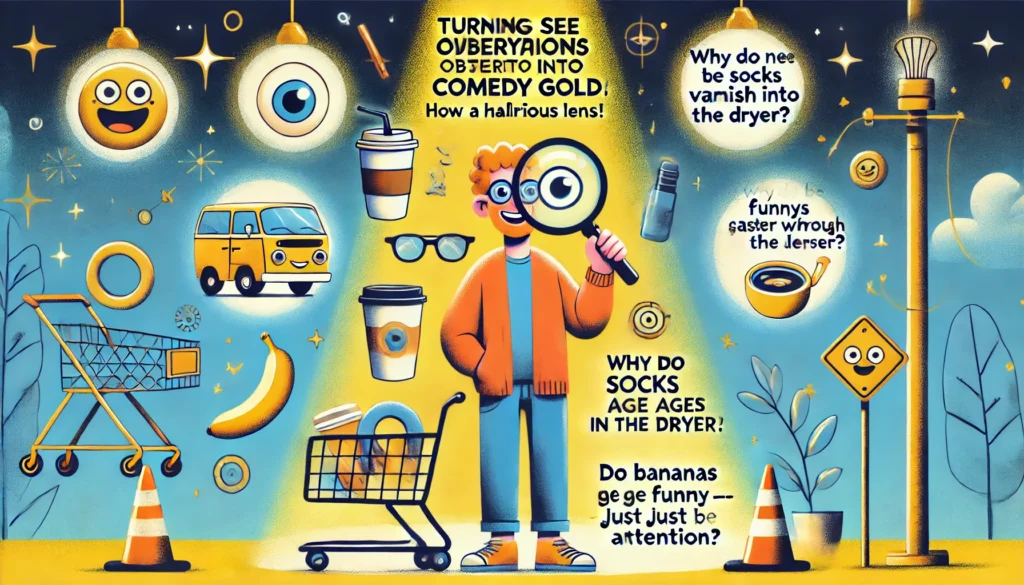
by Turning Everyday Observations into Comedy Gold
How to See the Ordinary Through a Hilarious Lens
You Don’t Need to Be “Funny” — You Just Need to Pay Attention
Great comedians aren’t always the loudest or wackiest people in the room — they’re often the ones sitting quietly in the corner, noticing that the hotel waffle iron looks like a medieval torture device, or that no one really knows how to walk past someone in a narrow hallway without doing an awkward little dance.
Comedy gold lives in the ordinary. The magic trick? Turning everyday life into something sharper, stranger, and funnier than anyone expected. This guide will show you how to do exactly that — whether you’re a stand-up comic, a writer, a speaker, or just someone who wants to see the world through a more hilarious lens.
Section 1: Why Observational Comedy Works
Observational comedy connects because it taps into shared reality — the weird, specific, often unspoken things we all deal with. When a comic says something like, “You ever open your fridge, stare at it for five minutes, and still grab the same sad tortilla?” the crowd isn’t just laughing — they’re recognizing themselves.
The best observational comics act as:
-
Anthropologists of awkwardness
-
Detectives of the mundane
-
Linguists of body language, silence, and missed connections
In other words: they don’t just make jokes. They notice first. And then they shape what they notice into laughs.
Section 2: Train Yourself to Notice the Stupid Stuff
You’ve probably already seen the things worth joking about — but you might not have been paying attention.
Here’s how to start noticing comedy in real time:
1. Keep a Comedy Log
Every day, write down:
-
Something dumb you did
-
Something dumb you saw
-
Something that made no sense
Even one line a day trains your brain to start filtering reality for material. (If you don’t think anything funny happened, go back and reread your group texts.)
2. Use the “Double Take” Test
If something makes you stop and go, “Wait, what?”, write it down. Confusion is comedy fertilizer.
-
Why does hotel shampoo come in a bottle the size of a thimble?
-
Why do we say “take a seat” when we’re clearly giving one back?
3. Observe with Specificity
Funny lives in the details:
-
Not “My dog did something funny.”
-
Try: “My dog tried to ‘play dead’ but kept peeking at me to see if I was watching. He faked his own death like a little furry tax evader.”
Section 3: Turn Raw Material Into Comedy Setups
Let’s say you notice something relatable or weird. What’s next?
You take that raw material and shape it into a setup — the part of the joke that builds the world and expectation.
Here’s how:
The Format:
SETUP = Observation + Clear Premise + Point of View
Example:
Observation: Airplane snacks are tiny and weird.
Premise: Airlines think feeding you four pretzels counts as hospitality.
POV: I’m a hungry, slightly offended adult.
→ SETUP: “Why is airplane food just a sealed envelope of salt and lies?”
From here, we can build to a punchline.
Section 4: Find the Punchline in the Twist
The punchline breaks the expectation you’ve just built — ideally with:
-
A surprising metaphor
-
A reversal or exaggeration
-
A brutally honest truth bomb
Let’s go back to the airplane snack setup:
Punchline 1 (Surprise): “They give you five pretzels — just enough to make you regret your mouth still works.”
Punchline 2 (Exaggeration): “I needed more carbs so I ate the napkin.”
Punchline 3 (Truth): “I think they feed us like that so we forget we’re hurdling through the sky in a tin can.”
Section 5: Build It Into a Bit
Once you’ve got a setup and punchline, you can start stacking:
-
Tags – follow-up jokes that add to the idea
-
Callbacks – reference earlier jokes for extra laughs
-
Act-outs – physically reenacting the moment
Example:
Setup: “Dating apps are just slot machines for sadness.”
Punchline: “You swipe, you lose, you still end up eating noodles alone.”
Tag: “I don’t even match with the bots anymore. One ghosted me after we matched. Like… you’re code.”
Act-out: Mimic scrolling through absurd profiles.
Section 6: Add Height — Make It Bigger or Weirder
Good comedy doesn’t just observe — it amplifies.
If something’s a little funny in real life, your job is to zoom in, twist it, or blow it up.
Let’s say you’re joking about forgetting people’s names. Try these heightening moves:
-
Zoom in: “It’s not that I forget names — it’s that I invent better ones in my head and then believe them.”
-
Twist it: “I once introduced my coworker as ‘Spreadsheet Guy.’ His name is David.”
-
Blow it up: “My own mom? In my phone as ‘Probably Mom.’ Just to be sure.”
Section 7: Avoid the Trap of “Only Funny to You”
Not all personal observations become comedy gold — and that’s okay. The test:
Is it funny to others, or just weirdly therapeutic for me?
If it’s deeply personal, you’ll need context, framing, and maybe editing to turn it into a shareable laugh.
Section 8: Use This Cheat Sheet to Build New Jokes
The Observation-to-Bit Blueprint
-
What weird moment did you notice?
-
Why did it feel confusing, frustrating, or relatable?
-
What do most people expect in that moment?
-
What surprising angle can you bring to it?
-
How can you exaggerate or escalate it?
-
Bonus: Can you act it out or call back to it later?
Section 9: 10 Everyday Prompts for Material Mining
Use these prompts to build your next set (or funny paragraph):
-
“The weirdest thing about public restrooms is…”
-
“I realized I’m officially an adult when…”
-
“You ever try to look cool while…”
-
“Why do we pretend to understand…”
-
“Every group chat has someone who…”
-
“I wish someone warned me that adulthood includes…”
-
“The dumbest argument I’ve had lately is…”
-
“When I shop online, I turn into…”
-
“My relationship with my phone is like…”
-
“Nothing makes me more irrationally angry than…”
Section 10: Final Tips — How to Polish the Gold
-
Read it out loud – timing, rhythm, and tone matter. If it’s funny on paper but dies onstage, tweak it.
-
Cut the clutter – the fewer words between the setup and punchline, the better.
-
Replace generalities with specifics – “shoes” → “Velcro sandals”; “food” → “cold mozzarella sticks”
-
Lean into your POV – make it sound like you.
Conclusion: Funny is Everywhere — If You’re Looking
Everyday observations are raw diamonds — weird, jagged, unpolished moments. The comic’s job is to dig them up, carve them down, and hold them to the light just right so the audience can say: “That’s exactly it — I just never saw it that way.”
So next time you:
-
Wait on hold
-
Hear a weird phrase at work
-
Accidentally wave back at someone who wasn’t waving at you
…pay attention. Comedy is everywhere. And the world is handing you material — if you’re sharp enough to catch it.