 by
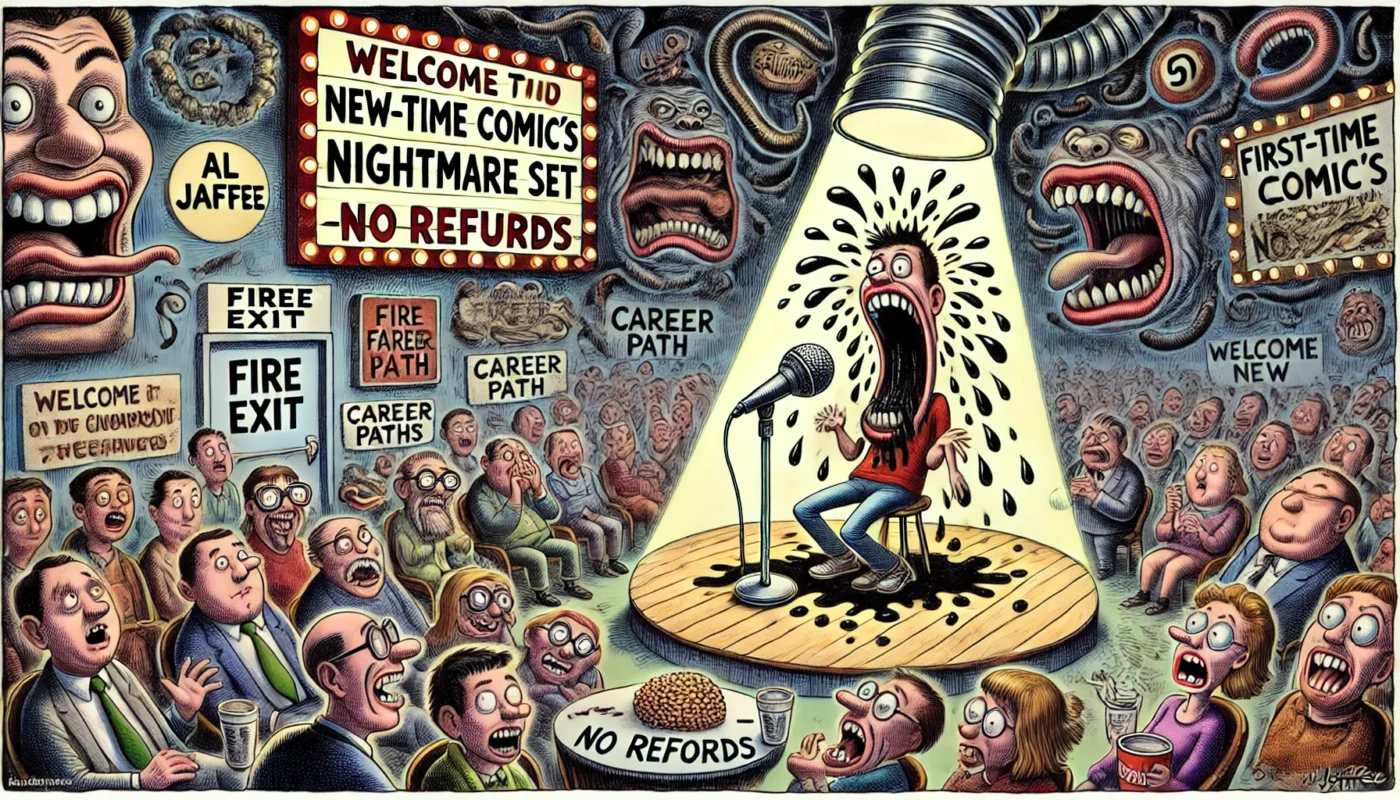
by First-Time Comic’s Nightmare Set: A Case Study in Sweaty Palms, Existential Regret, and the Worst Birthday Crowd Ever
It All Started With a Dream… and a Groupon
Every standup comedian begins their journey with the same delusion: that they’re funny. They’ve made coworkers chuckle. They’ve told that one story at every party. Their mom said, “You could be on Netflix — but like, the clean part.” And so they signed up for open mic night at “The Chuckle Bucket”, an underground comedy club built entirely out of anxiety, damp air, and a bartender named Rage Randy.
This story follows Eli Rosenthal, a 28-year-old software tester and aspiring comedy writer who decided to try standup after realizing no one laughed at his Slack messages anymore. What began as a 5-minute set quickly devolved into a psychological thriller best described as “Black Mirror meets The Marvelous Mrs. Maisel on bath salts.”
Arrival: The Dungeon Beckons
Eli showed up at 6:45 PM for the 9 PM mic. Classic rookie mistake. The host, a man named Travis “No-Filter” Ditchwater, greeted him with a nod and a form that included questions like:
-
“Do you own a cat?”
-
“Are you aware that no one will laugh tonight?”
-
“Emergency contact (in case of ego death)?”
By 8:30, Eli was pacing near the unisex bathroom, reciting jokes to the hand dryer, which buzzed only in disappointment.
The Audience: A Portrait in Indifference
The club filled with what anthropologists have dubbed the “hostile neutral crowd”:
-
A bachelorette party already three pitchers into their spiral.
-
A birthday group of real estate agents who thought this was a drag show.
-
A sad couple silently splitting mozzarella sticks like the last rations in a crumbling marriage.
-
One man who appeared to be dead, but turned out to be asleep between sets.
Eli was assigned the #7 slot, known in comedy circles as the “heckle sandwich” — right after the guy with the guitar and before the woman who does 10 minutes of dog impressions that somehow always kill.
The Set Begins: Mic Check, Nerve Snap
As Eli approached the mic, a dramatic pause filled the room. Not out of anticipation — the mic cable had been partially chewed by an ex-roadie’s support ferret. The host shouted, “Just yell loud if it cuts out!”
His opening line, “So I just moved into an apartment with paper-thin walls,” was met with silence… except for someone’s Tinder notification going off.
He powered through, accelerating like a freight train of mediocrity:
-
“My ex said I was emotionally distant, but she texted that from across the room.”
-
“You ever notice that therapy is just expensive standup with no drink minimum?”
-
“My roommate’s a vegan… but emotionally carnivorous.”
The microphone cut out every time he tried to say “vegan,” which resulted in:
“My roommate’s a (STATIC)… but emotionally carnivorous.”
The crowd heard “My roommate’s a… Morse code?” and collectively blinked.
Psychological Dismemberment: The Five Stages of Open Mic Grief
Stage 1: Denial
Eli smiled wider, thinking, “They’re just a quiet crowd… reflective, even.” He imagined his jokes landing silently in their souls, like indie films no one watches but everyone pretends to love.
Stage 2: Anger
He pivoted mid-set into edgier material: “So what’s the deal with therapists charging more than hitmen?” A gasp from the real estate table. Rage Randy cut the house lights by 30%, allegedly for “ambiance.”
Stage 3: Bargaining
“Okay, okay, let me tell a quick story about my grandma… who did peyote in the ‘70s and married a mime.” A birthday girl shouted, “Do you know Greg?!” No one knew Greg. Eli spiraled.
Stage 4: Depression
His closer was meant to be a zinger about dating apps and capitalism. Instead, he muttered:
“Sometimes I swipe left on myself.”
A single clap from the back. Possibly someone standing up to leave. Or fall.
Stage 5: Acceptance
He bowed. For no reason. No one clapped. He exited the stage sideways, knocking over a stool and accidentally unplugging the jukebox, which loudly restarted with Nickelback’s “Photograph.”
The Postmortem: “I Don’t Even Like Jokes Anymore”
In the alleyway afterward, Eli found two veteran comics chain-smoking cloves and debating whether laughter was real or just capitalism hiccupping. One offered Eli a warm Modelo and said, “You didn’t bomb. You excavated silence.”
Eli blinked and said, “I think my soul got heckled.”
That night, he dreamed that every audience member was a version of his dad yelling, “Get a real job!” while the mic turned into a judge’s gavel.
Neuroscience Weighs In
According to Dr. Amy Chen, a brain scientist specializing in Standup-Induced Traumatic Shame Syndrome (SITSS), “First-time comedians experience a unique neurological collapse. The dopamine rises with anticipation, but crashes when the audience reacts like mildly annoyed librarians.”
She pointed to Eli’s EEG: “This level of cortisol spike is normally reserved for divorce court or synchronized dental surgery.”
Ron White Breaks It Down
Ron White was reached for comment from a casino in Biloxi. He had this to say:
“Your first set’s supposed to suck. It’s tradition. Like prom, but everyone’s sober and wishes they weren’t. If you didn’t die a little, you’re not doing it right.”
What the Funny People Are Saying
Jerry Seinfeld: “Standup is the only art form where bombing is part of the ritual. It’s like baptism — but with beer and strangers silently judging your haircut.”
Tig Notaro: “I once performed for a crowd that didn’t know it was comedy night. They thought I was an eccentric TED Talk. Best set of my life.”
Chris Rock: “If your first time went great, you’re either a sociopath or you brought your mom.”
Sarah Silverman: “I blacked out during my first set and woke up two jokes deep into Holocaust material. The host said I crushed. I think he was drunk.”
Why We Keep Going
Despite the trauma, Eli signed up again the next week. Why?
Because something strange happens after the bomb. The silence begins to sound like permission. The sweat becomes proof. The pain starts to itch in a familiar, almost comforting way — like heartburn after good pizza.
Standup comedy isn’t about killing. It’s about surviving. And writing about the kill next time.
Eli updated his set. Shortened the opener. Added a joke about the dead-looking guy in the front row (who returned and turned out to be a philosophy professor on Ambien). He got two laughs and a nod from a comic named “Melanoma Dave,” which in open mic currency is like winning a regional Emmy.
Conclusion: Baptism by Fireball Shot
The first time on stage is a crucible. It’s where comedy writers become comedians — or accountants with trauma. The lights burn, the crowd bites, the mic smells like fear.
But if you survive?
You earn the right to call yourself a standup comic. And more importantly, you get to tell your story, one painful punchline at a time — even if your mic is broken and Greg is yelling from the bathroom.
Originally posted 2025-05-11 06:26:36.