 by
by Writing for the Unexpected: The Element of Surprise
How to Craft Comedy That Catches People Off Guard
The Power of the Left Turn
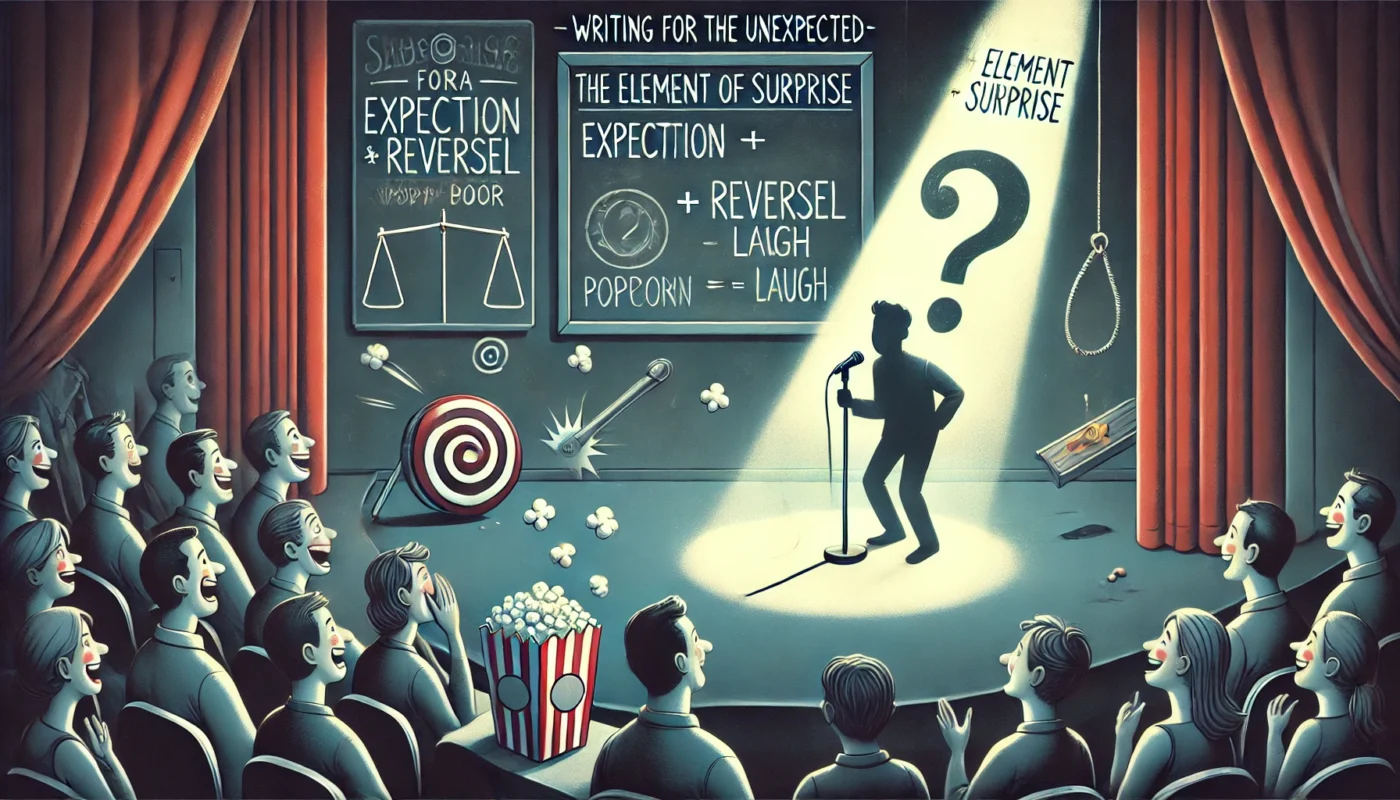
Good comedy entertains. Great comedy surprises. The element of surprise is one of the most powerful tools in a comedian’s toolkit. It’s what makes audiences gasp, laugh, snort, or shout “I did not see that coming!”
Whether you’re writing a joke, a sketch, or even humorous dialogue in a speech, surprise is the engine behind the laugh. It’s the flip — the moment the audience realizes they were wrong about where you were going, and they’re delighted to be proven wrong.
You don’t need to be outrageous to be funny. You just need to be unexpected.
This guide will show you how to:
-
Understand the psychology behind surprise in humor
-
Structure jokes that mislead (in the best way)
-
Use tension, timing, and reversal to heighten impact
-
Avoid cliché setups and predictable punchlines
-
Practice writing that zigzags — not in circles
By the end, you’ll know how to take your audience down one path… and joyfully yank them in another direction.
Part 1: Why Surprise Works (The Psychology Behind It)
Laughter is a reflex — it often comes from a sudden release of tension. Our brains are wired to make predictions all the time. That’s how we survive: we anticipate what’s going to happen next based on patterns.
Surprise interrupts those patterns.
In comedy, surprise happens when:
-
A pattern is set
-
An expectation is built
-
That expectation is broken, suddenly and cleverly
It’s this break in expectation — the little “error” — that makes our brain stumble, and then release that tension through laughter. It’s the mental version of slipping on a banana peel, then realizing it was placed there on purpose.
Comedy = Setup + Subversion + Timing.
Part 2: The Basics of a Surprise Punchline
Let’s break it down.
🔹 The Setup
The part of the joke that builds a logical, believable world. You’re leading your audience into a room.
“I told my therapist about my social anxiety…”
This sounds like it’s going somewhere heartfelt. But…
🔹 The Punchline
This is where you twist the premise into something absurd, exaggerated, or painfully honest.
“…and she asked me to leave the room so she could calm down.”
That’s a punchline based on role reversal and absurd logic. The therapist — the professional — is now the one overwhelmed. Surprise.
Part 3: Techniques for Writing the Unexpected
Surprise is not just about saying weird stuff. It’s about precision. Below are several proven strategies.
✅ 1. The Misdirection
This is the most classic technique. You set up an idea that feels familiar, then hit the audience with something completely different — yet still logically connected.
Setup: “My grandfather has the heart of a lion…”
Punchline: “…and a lifetime ban from the zoo.”
Why it works: You lead the audience toward sentimentality, then veer into absurdity.
✅ 2. The Reversal
Take a social norm or assumption and turn it on its head.
“I’m not good with confrontation. I once apologized to a chair for bumping into it. Then I sat in another chair to avoid a second conversation.”
Why it works: People expect awkwardness in small doses. You keep escalating.
✅ 3. The Unexpected Analogy
Say something in a wildly original way — through metaphor or comparison — that no one saw coming.
“Dating in your 30s is like trying to return expired yogurt — it’s possible, but no one’s really happy about it.”
✅ 4. The Relatable Twist
Take something universal, then skew it.
“I thought I was a strong, independent woman… then I tried to open a new trash bag without crying.”
Why it works: The setup feels empowering. The punchline flips that confidence into something painfully human.
✅ 5. The Act-Out Surprise
Sometimes the way you perform a line — through timing, silence, or physical delivery — becomes the surprise.
“I told my date I’m emotionally available. She asked what that means.
[pause]
So I texted my ex.”
The pause is where the laugh lives. The delivery creates surprise.
Part 4: Avoiding the Obvious — Kill the Predictable Punchline
The biggest threat to surprise is familiarity. If your audience sees the punchline coming, it’s not funny — it’s confirmation, not subversion.
How to fix this:
-
Rethink common premises (dating, coffee, traffic) from new angles.
-
Avoid overused words like “Karen,” “Netflix,” “Tinder,” unless you’re subverting them.
-
Don’t rely on shock value. Gross or offensive is not the same as unexpected — and it’s usually lazy.
🔄 Practice Drill: The “Obvious Kill”
-
Write a short setup.
-
Write the first punchline that comes to mind.
-
Cross it out.
-
Write three more.
-
Use the fourth one.
Surprise requires digging past the surface.
Part 5: Build Tension Before You Break It
Surprise is more powerful when there’s a little suspense. That’s why timing is essential.
⏱ The Beat Before the Boom
The longer the pause before the punchline (within reason), the more time your audience has to guess where you’re going. That means the payoff can be bigger — if you prove them wrong.
Don’t rush. Let the silence work for you.
Part 6: How to Practice Surprise Writing
Here are practical exercises to strengthen your surprise muscles:
✏️ Exercise 1: Rewrite Clichés
Take a well-known phrase or saying and rewrite it with a twist.
-
“You miss 100% of the shots you don’t take.”
→ “You miss 100% of the shots you take after eating gas station sushi.” -
“Early bird gets the worm.”
→ “Early bird gets the worm. Late bird gets Wi-Fi and no regrets.”
✏️ Exercise 2: Flip the Roles
Write a scenario, then flip who’s in control.
Normal: “The teacher scolded the student.”
Flipped: “The student gave the teacher detention… for emotional immaturity.”
This reversal is unexpected — and makes people laugh.
✏️ Exercise 3: Wrong Reactions
Describe someone reacting to something in a completely inappropriate or unexpected way.
“She found out her boyfriend cheated, so she congratulated him on finally finishing something.”
Part 7: Elevate Surprise With Callback and Escalation
Surprise doesn’t have to end after one punchline. You can stretch it.
🔁 Callback: Refer back to a previous joke — in a new context.
Early joke: “I panic when I see unread emails.”
Later callback: “I ghosted someone once… because they sent me an email.”
🔺 Escalation: Keep raising the stakes.
“I’m not competitive.
Except at board games.
And parking.
And breathing near someone on the treadmill.”
Each line makes it more absurd, heightening the original joke.
Part 8: Real-World Examples — Broken Down
Here are short examples from working comedians that demonstrate excellent surprise writing:
Mitch Hedberg
“I used to do drugs. I still do, but I used to, too.”
Why it works: It sounds like a confession. Then it unravels into perfect nonsense — while still making weird, logical sense.
Ali Wong
“People say ‘You’re glowing!’ when you’re pregnant. It’s not glow — it’s sweat. From carrying a human. Inside your body. While walking uphill. On fire.”
Why it works: She sets up a cliché compliment — then obliterates it with brutal honesty and exaggeration.
Nate Bargatze
“My wife and I have a safe word for arguments. It’s ‘I’m wrong.’”
Why it works: A familiar setup (relationship dynamics) turned on its head with a perfectly dry twist.
Part 9: Bonus — Use Visual and Structural Surprise
Surprise isn’t limited to content — you can surprise with form.
-
A list that gets weirder as it goes on
-
A story that loops back to the beginning
-
A visual gag in slides or on stage
Audiences like to feel like they’re on a rollercoaster. Keep them guessing.
Conclusion: Surprise is the Soul of Comedy
If there’s one through-line in every killer bit, every viral tweet, every unforgettable stand-up moment — it’s surprise. When you can make people think they know where you’re going… then make a sharp, clean turn, you earn their laugh.
Surprise is what keeps your writing alive.
So the next time you write a joke, a paragraph, or even just a tweet, ask yourself:
“What’s the most unexpected — but true — way to say this?”
That’s where the comedy lives.
Originally posted 2025-05-17 14:12:24.