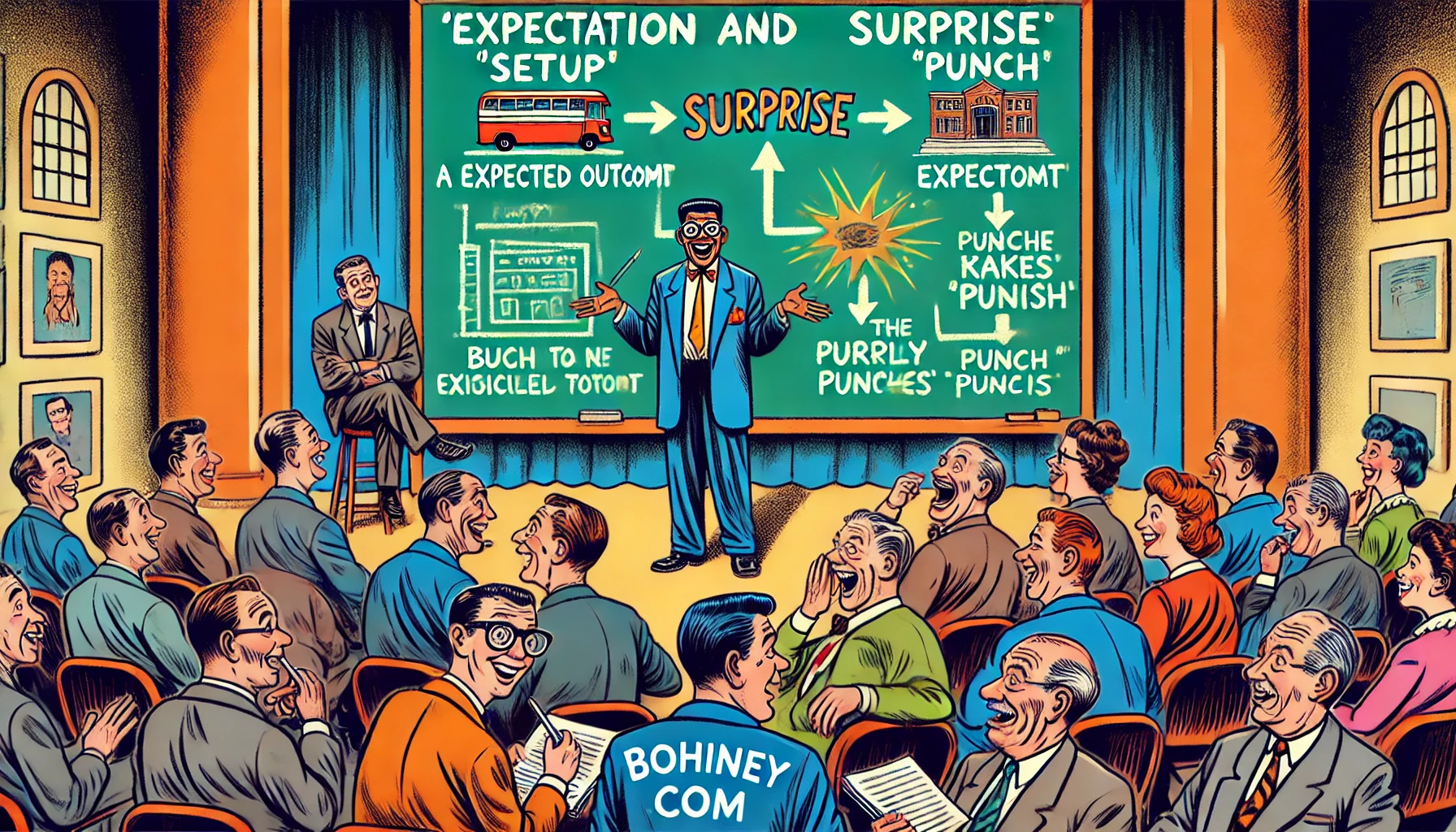
What Jokes Do: The Magic of Expectation and Surprise
Jokes: The Original Bait-and-Switch
Jokes are basically verbal magic tricks—they set up an expectation, then yank the rug out from under it, leaving you either laughing or questioning your life choices.
The secret ingredient? Surprise.
Imagine you walk into a bakery, order a croissant, and instead, the baker hands you a goldfish. That moment of sheer confusion? That’s comedy. But only if no one calls animal control.
The Setup and the Punch: The Comedy One-Two Punch
All jokes have two essential parts:
- The Setup: This is where the audience is gently guided toward an expectation. (“Oh, I see where this is going,” their brain thinks smugly.)
- The Punch: This is where that expectation is shattered like a piñata full of disappointment. (“Wait, WHAT?!”)
Take this classic joke:
“I’m on the Drinking Man’s Diet. It really works. I’ve already lost three days.”
- Setup: “I’m on the Drinking Man’s Diet. It really works.” (Oh, he’s losing weight! I get it!)
- Punch: “I’ve already lost three days.” (Nope! He’s just blacking out!)
The audience expects weight loss, but instead, they get time loss. The result? Laughter, or at the very least, the realization that maybe this diet shouldn’t be FDA-approved.
Surprise is the Key—Because the Brain is Lazy
Humans like predictability. The brain LOVES to assume it knows what’s next—until a joke smacks it in the face and says, “Not today, Einstein.”
That’s why we find surprise funny. It’s the same reason why watching a toddler walk confidently into a glass door is hilarious (don’t pretend you haven’t laughed at that).
Jokes disrupt patterns. That’s why a good joke never ends the way you expect. If it does, that’s not a joke—that’s just a sentence.
Why Can’t Everyone Write Jokes?
You now understand how jokes work. So why aren’t you writing for late-night TV yet?
Because knowing how a joke works and actually writing one are two different things.
Think of it this way: just because you know how a car works doesn’t mean you can build an engine.
Comedy requires the ability to:
- Spot expectations people naturally have.
- Create a misdirection that leads them to the wrong assumption.
- Deliver the punchline in a way that maximizes surprise.
And, most importantly: Don’t explain the joke. (Unless you want to kill it faster than a bad internet connection.)
Final Thought: Comedy is Just Controlled Disappointment
Jokes work because they promise one thing and deliver another. It’s controlled chaos. If jokes were people, they’d be unreliable narrators with a fantastic sense of timing.
And remember: the best way to learn comedy is to write terrible jokes until they get better.
But no rush—you can always start tomorrow… or the next day… or the next…
